Most days I feel like the ring leader of a very busy circus. Whether I'm navigating the news of the AI industry or jumping through hoops for my three energetic kids, one thing is certain: the chaos is continuous.
If you're like me and your brain constantly feels like 14 browser tabs are open at the same time, trust me, I get it. Life is busy and often mentally tough no matter who you are, which is why multitasking is often a survival tactic.
It's why I started using what I now call the “circus” prompt with ChatGPT. It works by essentially dumping whatever chaotic mess you're struggling with into ChatGPT and asking it to make sense of all the "acts" in your three-ring circus. Oddly enough, it works shockingly well.
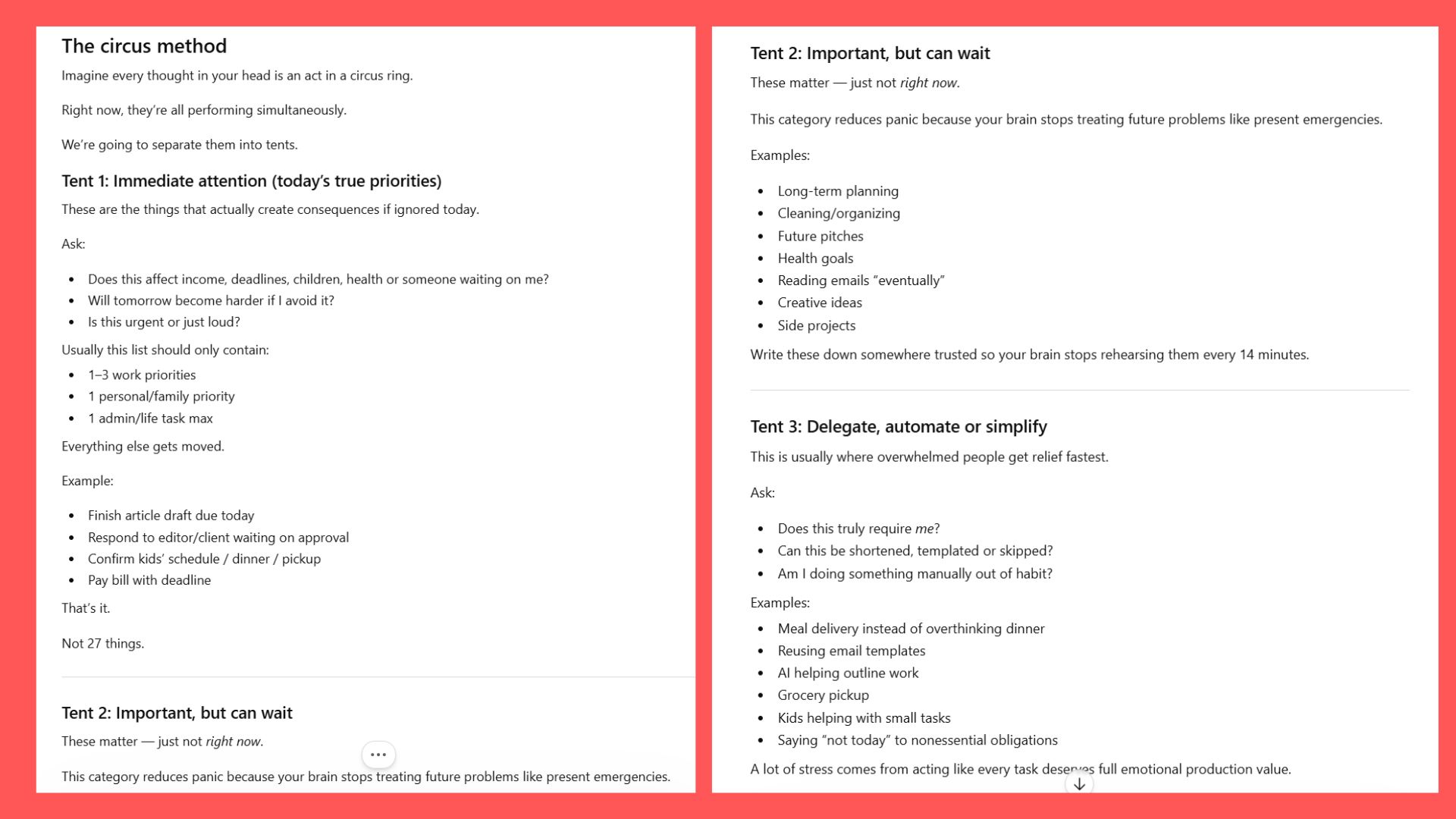
Instead of giving me another overwhelming to-do list, ChatGPT helped me separate what was urgent, what only felt urgent and what was quietly draining my attention in the background.
The ChatGPT ‘circus’ prompt
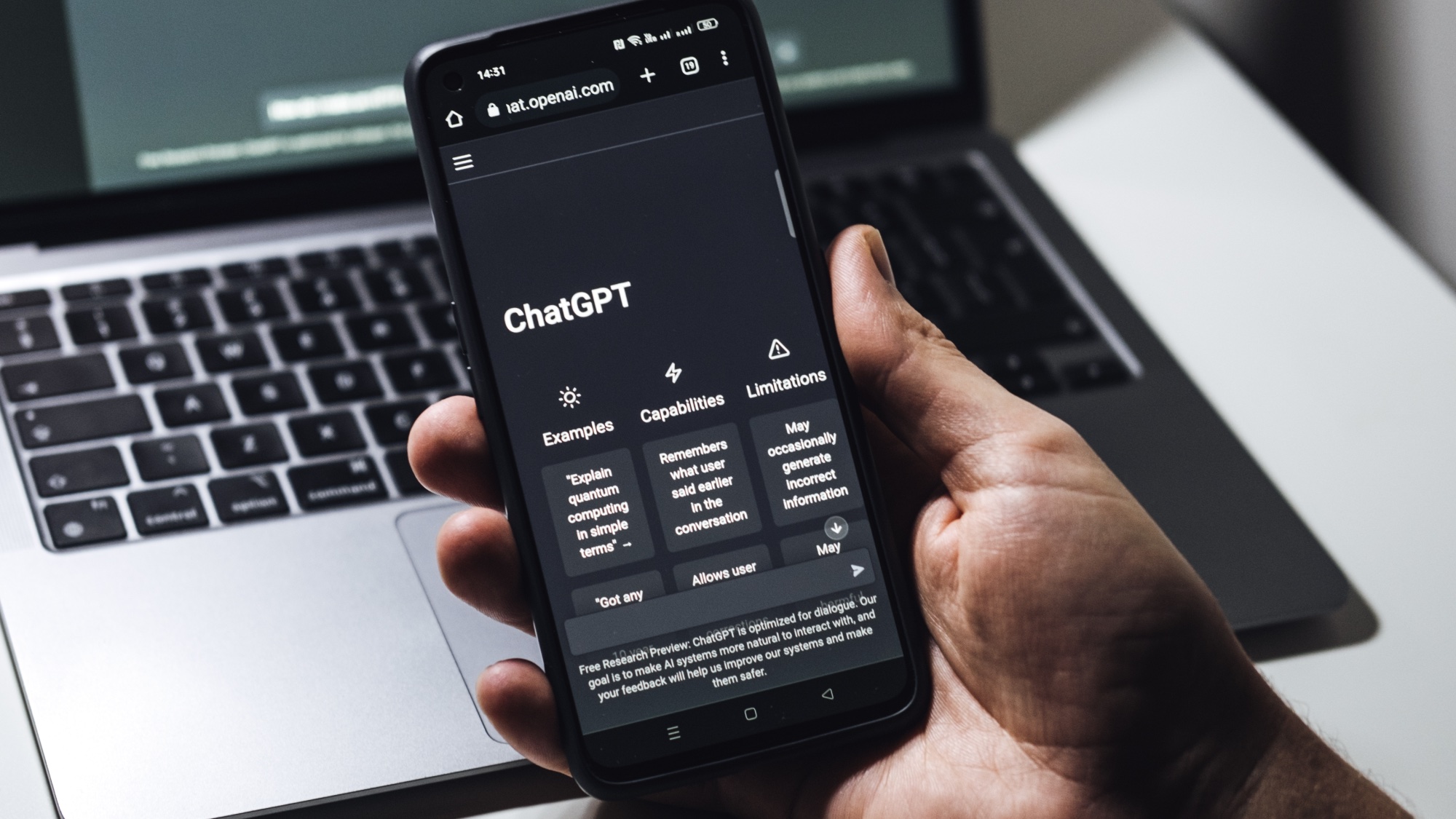
Here’s the exact prompt I use — and why it’s become one of my favorite AI tricks for multitasking:
“My brain feels like a circus with too many acts happening at once. I’m juggling work tasks, personal responsibilities, distractions and mental clutter. Help me organize everything into categories: What needs immediate attention, what can wait, what I should delegate, automate or ignore and finally what’s taking up too much mental energy unnecessarily. Then, help me create a calmer game plan for the rest of the day.”
The magic of this prompt is that it forces ChatGPT to think like a prioritization coach. You can manually enter everything you've got going on or take screenshots of your calendar or text messages. I've even included what I'm anxious about and what the next few days look like.
Just remember, you're not asking ChatGPT to "make a schedule" for you. That would be an entirely different prompt. Instead, you're asking it to flag what's dragging you down and taking up far too much of your mental energy.
Instead of simply organizing tasks chronologically, it helps identify which tasks are creating unnecessary cognitive noise. And, you can customize it for almost anything from parent overload and work burnout to preparing for a busy week.
You can even ask ChatGPT to turn the output into a color-coded schedule, a simplified checklist, a “minimum viable day,” a deep-work plan or step-by-step shutdown routine. The more honest you are with the input, the more useful the output becomes.
Why this works so well
Some days, my life feels like a reality show. Usually I end up laughing at the chaos — like when my preschooler casually pulls a frog out of his pocket, my middle schooler invites half his friend group over without asking or my daughter decides to cut her own hair upstairs instead of doing homework. But when everything starts happening at once and my brain feels maxed out, this prompt genuinely helps me slow down and calm the noise.
A lot of productivity systems assume your tasks are already organized and logical. Mine are anything but because life gets in the way. The problem is most people struggle because everything feels equally important at the same time and they are juggling too much.
But the “circus” prompt works because it gives structure to both physical overwhelm and emotional overload.
When I use it, ChatGPT almost always notices how much time I spend context switching from one activity to the next. I'm always bouncing around, which can lead to constant mental fragmentation. With this prompt, ChatGPT examines what tasks and projects could be batched together or even temporarily muting low-priority tasks. That alone makes my afternoons feel dramatically calmer.
ChatGPT helps you find your 'rings'
Using this prompt, ChatGPT helps separate "emotionally loud" tasks from genuinely important ones and puts them into what I call "rings." Just like a circus, the tasks can happen simultaneously, but do not have to overlap and strain thinking.
In my case, ChatGPT pointed out that several things stressing me out (admin work, chores or conversations) would take less than five minutes to finish entirely.
Meanwhile, larger projects requiring deeper focus kept getting delayed because smaller tasks kept interrupting them. That’s where the prompt becomes surprisingly insightful. It simply helps me step outside the chaos long enough to see which acts actually belong in the show.