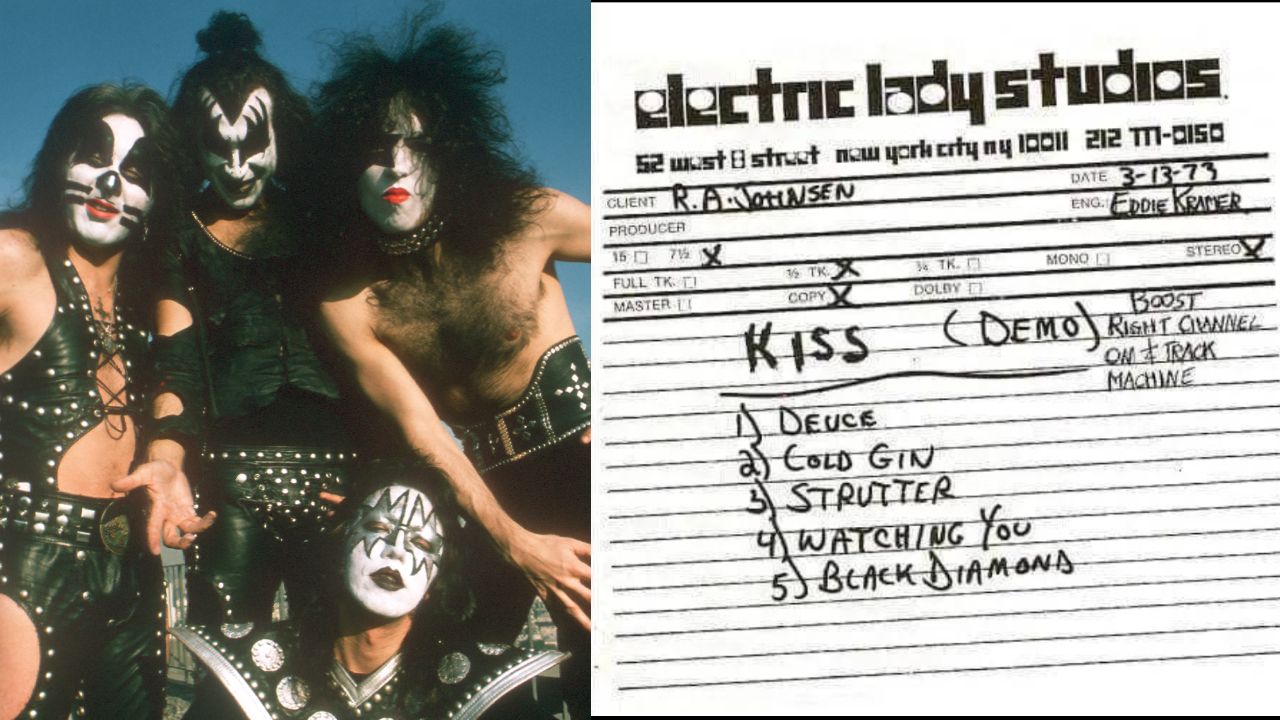
Eddie Kramer had already worked on records by The Beatles, Jimi Hendrix, the Rolling Stones, Small Faces and Traffic in London before he relocated to America in 1968, Five years later, while working as Director of Engineering at Hendrix's Electric Lady Studios, the English producer would help introduce the world to another artist who would change the face of rock music: Kiss.
"I used to see Gene [Simmons] and Paul [Stanley] at Electric Lady Studios, walking down the corridor with their manager [Ron Johnsen]," Kramer tells YouTube personality Rick Beato in a new interview, recalling that, at the time, the pair were doing, "Beatles kind of stuff" with their band Wicked Lester, but that the record they had made together had been been shelved, because "apparently it wasn't good record."
"So, I get the call from their manager," Kramer continues. "'Gene and Paul have come up with a concept... it's going to be a rock and roll album. Would you be interested? Could you cut a demo for us?' I said, Yeah, I'll do a demo, but we're going to do it the old fashioned way: four track, Studio B, one day, that's all you got."
"So, on the appointed day [March 13,1973], here comes Peter [Criss]with his drums. 'Hey, man. What's up?' From Brooklyn, you know, nice guy. There's Paul and Gene, and we were setting up all the instruments, and here comes Ace [Frehley]. He walks in the door and he's so skinny if he turns sideways you wouldn't have even see him. He was driving a cab all night at the Bronx, but the moment he plugged in and played I said, Here's a great guitar player. Love that guy. God rest in peace."
The five songs that Kiss recorded that day became the key components of the band's self titled debut album, released by Casablanca on February 8 the following year.
"My game plan was to capture the spirit of the band," Kramer recalled in writer Ken Sharp's biography. Nothin’ To Lose: The Making of KISS (1972-1975). "It’s like a time capsule in a way. You grab that moment when the energy is at its raw peak and try not to overembellish. You want to capture the vibe. And that’s the trick. I was very fortunate I was able to do that with KISS on that demo."
“We put down pretty much who we were," Paul Stanley told Sharp. "It was like a musical manifesto. The demo is much rawer than the first album. In many ways I don’t think anything captured the magnitude of what we were doing just in terms of its sonic scope.”