Rail travellers on intercity trains usually find wifi is a serious disappointment. Although provided free, it is often unusable. Staying connected with the outside world is tricky and frustrating, with many people simply crossing their fingers and relying on their mobile phone hotspots – which all too often turn into “notspots”.
Yet allowing passengers to be connected while on the move is crucial for the railways – currently consuming billions of pounds in subsidies. To attract new business, the rail industry needs to show travellers they can make the most of their time on board.
Connectivity is all the more crucial after the announcement by the transport secretary, Heidi Alexander, that HS2 will not be delivered for at least another decade – and that the high-speed link between London and Birmingham will be slower than originally planned.
“If you can't improve the journey time, it's all about improving the time on the journey,” says Nigel Blackler, lead officer for Peninsula Transport – the partnership for southwest England, currently served by GWR’s poor-performing wifi. “That’s about better wifi connectivity both for business users and for leisure travellers.”
Fortunately the cost of communication is on a downward trajectory, so things, as they say, can only get better across the nation.
What is planned?
The government has pledged to upgrade more than 1,400 trains to allow them to connect with a low-Earth orbit satellite network – transforming on-board wifi. A report in The Times says passengers on state-run LNER and TransPennine Express will be first to benefit.
In addition, a scheme called “Project Reach” plans to fit more than 70 tunnels and deep cuttings with lineside fibre-optic equipment to provide connectivity on stretches currently without coverage.
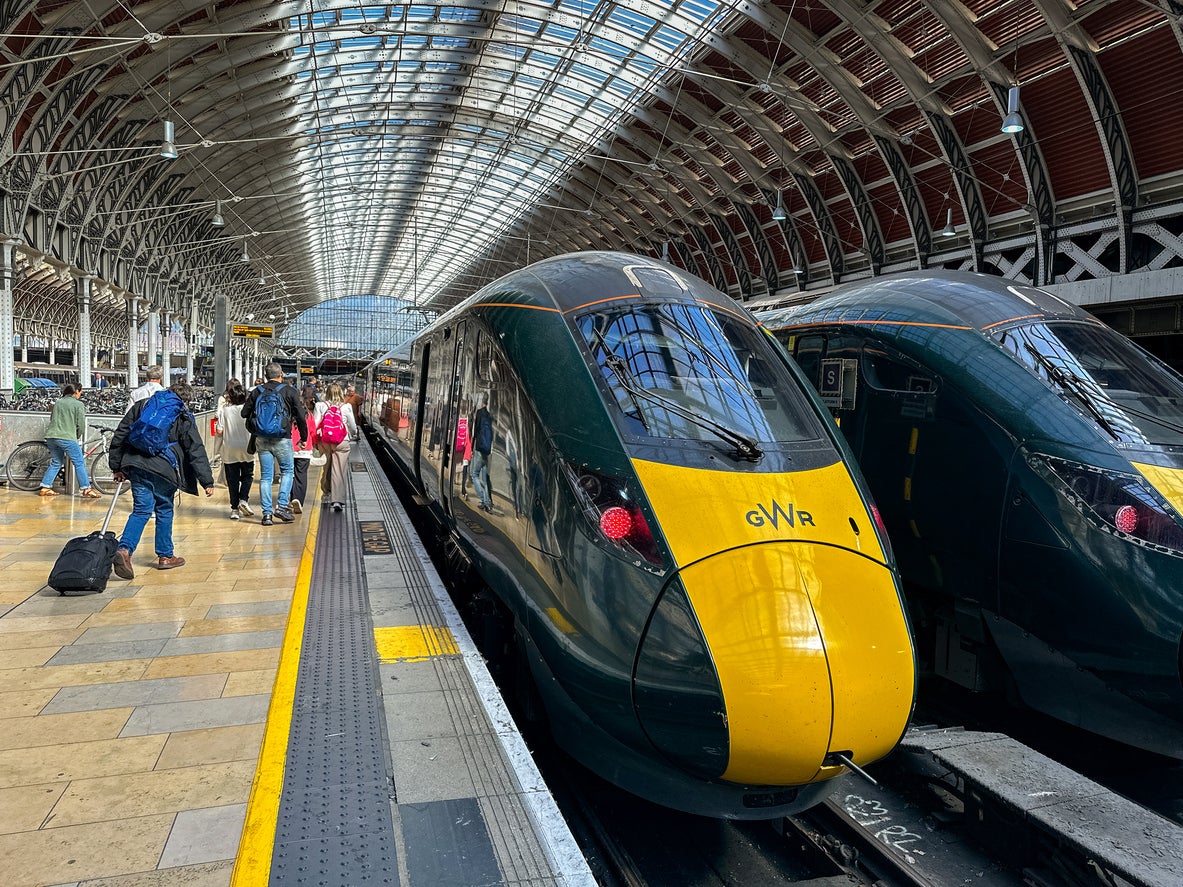
The plan has emerged six months after a single Great Western Railway (GWR) intercity express, unit 802101, was kitted out with technology pioneered by Formula One – to become Britain’s best-connected train. It relied on Elon Musk’s Starlink network.
Why is wifi on trains so bad?
The Victorian network on which almost all UK rail travellers depend was not built with the 21st-century desire for decent wifi on trains.
Most current onboard wifi depends on line-of sight reception from mobile phone masts. The challenging terrain prevents many people from being able to do any meaningful work involving the outside world.
The same applies to passengers who despair at what the train operator provides, and instead try to hotspot from their smartphones. A second problem is that steel rail carriages have something of a “Faraday effect” that reduces the penetration of exactly the electromagnetic signals that mobile phones use.
The service provided also depends on how many people are trying to share the signal. On a busy service, speeds are typically only one-fiftieth of those achieved at home – and patchy. As a result, the typical passenger might set their sights no higher than trying to send a few emails and do some basic social media stuff.
“On most trains, I think people usually give up,” says Nick Fry – chair of the communications company Motion Applied. “You try to use your mobile phone as best you can, but the connectivity is often so poor you don’t bother – you’re better off having a nap.” His organisation has pioneered the way

How does the tech work?
“We’re taking Formula One technology and applying it to wifi on trains,” says Fry. “There are some formidable challenges with both. In Formula One, the car is going around a circuit at very high speed. On grand prix Sundays there are hundreds of thousands of spectators, plus media and cameras, so the airwaves are crowded. That makes communication difficult.
“Trains are actually quite similar: they move quickly, go through cuttings, pass under trees, and carry lots of people.”
The test train seeks out the best connectivity at any one moment from a combination of Starlink satellites and 5G phone masts.
“It’s fundamentally different from a normal train wifi system,” says Fry. “On this train there are four pizza-sized boxes on the roof. Each contains antennas and a computer that works out where the best signal is. The boxes talk to each other and, unlike most systems, can connect to either a satellite or a ground station – sometimes both at once. They analyse the signal millisecond by millisecond to give you the best possible performance.”
“Most people will be able to go about their day-to-day business — talking to family, doing Teams calls, watching a movie. It’s genuinely transformative, and productivity will increase significantly.”

Does it make a difference?
The “show train” proved excellent. Download rates typically measured around 70 megabits per second while travelling at 125mph. That’s the sort of speed (70Mbps, not 125mph) that you’d expect to achieve at home.
On a test run I watched daytime TV without any latency. Connecting to the weekly travel planning meeting with my colleagues at The Independent was simple; the audio occasionally drifted off in the direction of Mars, but that may be our system issue.
Upload speeds are slower. While on the move, a 230MB video interview with Fry took about 45 seconds to upload to a transfer site.
A GWR spokesperson said: “We were pleased to work with Peninsula Transport and Hitachi Rail on the trial of high-tech wifi on board Intercity Express Train 802101, and the feedback from customers was extremely encouraging.
"We are now reviewing the results of the trial and hope to discuss options for the fitment of GWR trains over the next few months, taking advantage of potential funding opportunities.”
What is ‘Project Reach’
Network Rail is working with Neos Networks to deploy 625 miles of ultra-fast fibre-optic cable beside stretches of several intercity lines:
- East Coast Main Line, especially just north of London King's Cross.
- West Coast Main Line.
- Chiltern Main Line.
- Great Western Railway (including the long Chipping Sodbury Tunnel).
It should improve both direct access to better phone connectivity as well as improved onboard wifi.
The plan is to expand it beyond 3,000 miles in the future.
Which other parts of the railway perform well?
Generally the best connectivity you will find is at a Network Rail station, though even there the download speed is below 15Mpbs.
From personal experience, this is my top 10 of train operators.
- 1 Greater Anglia.
- 2 LNER (though you have to upgrade to first class for the best results).
- 3 Lumo, also on the East Coast Main Line.
- 4 Avanti West Coast.
- 5 ScotRail.
- 6 TransPennine Express.
- 7 East Midlands Railway.
- 8 GWR.
- 9 Cross Country.
- 10 Govia Thameslink, which throttles back the wifi after you’ve used a fairly modest amount.
In addition, the Elizabeth line is slow and patchy, but wins extra points for working underground.
Read more: Why is it so difficult to travel to – and through – Europe by train?