Solar panels can seem like a mysterious or complex piece of technology, but the basic idea is surprisingly simple: they capture energy from daylight and convert it into electricity your home can use.
For many homeowners, this is the main appeal. A solar photovoltaic (PV) system can reduce the amount of electricity you need to buy from the grid, helping to cut your energy bills over the long term. If your panels generate more power than you use, you may also be able to sell the excess back to an energy supplier through the Smart Export Guarantee (SEG).
But before deciding whether solar panels are worth it for your home, it helps to understand how they actually work and how their performance changes in the real world. Roof angle, shading, season, temperature and your household’s energy use can all affect how much electricity a system produces.
In this guide, we explain how solar panels generate electricity, what happens to their output in winter and hot weather, and the other key factors to consider before installing a system.
Get a quote for solar panels for your home
Use our comparison tool to get a range of free quotes from leading solar panel installers across the UK.
How do solar panels work?
Solar panels are devices that convert energy from sunlight into electricity you can use at home. The technology behind most domestic systems is solar photovoltaic (PV). Photovoltaic (PV) cells are made from layers of semiconducting material, typically silicon. When photons from daylight strike the cell, they transfer their energy to electrons in the material, causing them to move. This movement creates an electric current.
The electric current that's generated is then captured by a series of plates and wires within the solar panel and converted into a usable current that is delivered to your home. This energy can power anything in your home that runs on electricity, from your toaster to your TV.
Solar panels are designed with an anti-reflective coating and multiple layers to maximise light capture and efficiency. They typically come encased in glass to better protect the cells. Within that case, there is insulation to help regulate the temperature inside the panel. This is because if a solar panel gets too hot, its efficiency will drop.
In case you’re wondering, solar PV panels generate electricity, while solar thermal panels use the sun’s energy to heat water.
A simple explanation: daylight in, electricity out
As outlined, a solar PV panel contains lots of photovoltaic (PV) cells, usually made from silicon. When daylight hits these cells, it energises electrons inside the material, creating an electrical current. That current is direct current (DC).
Homes don’t run on DC, though; they run on alternating current (AC). That’s why every solar system includes an inverter, which converts the electricity into a usable form for your appliances.
Solar panels are also built to make the most of whatever light they can capture. They’re designed with multiple layers and coatings to reduce reflection and improve efficiency, and they’re protected by a glass casing. Inside the panel, insulation helps regulate temperature because if a panel gets too hot, its efficiency drops.
How solar panels convert daylight into electricity
Here's how solar panels work from the moment daylight hits your roof:
- Daylight hits the panels – even when it’s cloudy, PV cells can still capture some light.
- The panels generate DC electricity – electrons move through the PV cells, creating a current.
- The inverter converts DC electricity to AC so it’s suitable for your home.
- Your home uses the electricity first, powering anything that’s switched on, reducing what you need to import from the National Grid.
- Any leftover power has two routes: it can be exported back to the grid (usually via SEG), or stored in a battery for later.
Phil Steele, Future Technologies Evangelist at Octopus Energy, says it helps to think of solar generation in terms of both power and energy. “It’s like water,” he explains. “You’ve got the flow rate, which is kilowatts, and then the actual volume over time, which is kilowatt hours.”
It’s important to remember that solar isn’t free round-the-clock electricity. It’s daytime electricity, and the value you get depends on how much of it you use while it’s being generated.
As for leftover power, Steele says batteries are most effective when paired with solar because they allow households to store excess electricity rather than exporting it immediately. “I much prefer it when batteries are paired with solar,” he says, “because you’re storing your own energy to use later on.
“If you store that in your battery, then you can use that for free, effectively, instead of buying grid energy… You forego the, say, 15p you could have got from exporting it, but you're not then having to buy it back again at 27p.”
Are solar panels right for me?
The best solar installations are the ones designed around the realities of your home. A few practical factors make the biggest difference.
Roof space
Most households need around 10-25m² of clear roof area for a typical installation. How many panels you can fit depends on the model and the size of your roof.
Orientation and pitch
A south-facing roof is usually ideal in the UK, but east- and west-facing roofs can also work well. What you’re really aiming for is decent daylight exposure across the day. North-facing roofs tend to be less productive.
Shading
Trees, chimneys, neighbouring buildings, and even dormers can reduce output. A proper site survey should factor this in and design the layout accordingly.
Roof condition and strength
Solar panels add weight and need secure fixings. Your roof should be structurally sound and in good condition, especially if it’s older or if you’re considering a large system.
Permissions
Most homes in the UK don’t need planning permission for solar panels. However, if you live in a listed building or a conservation area, you may need approval.
Do solar panels work in winter and on cloudy days?
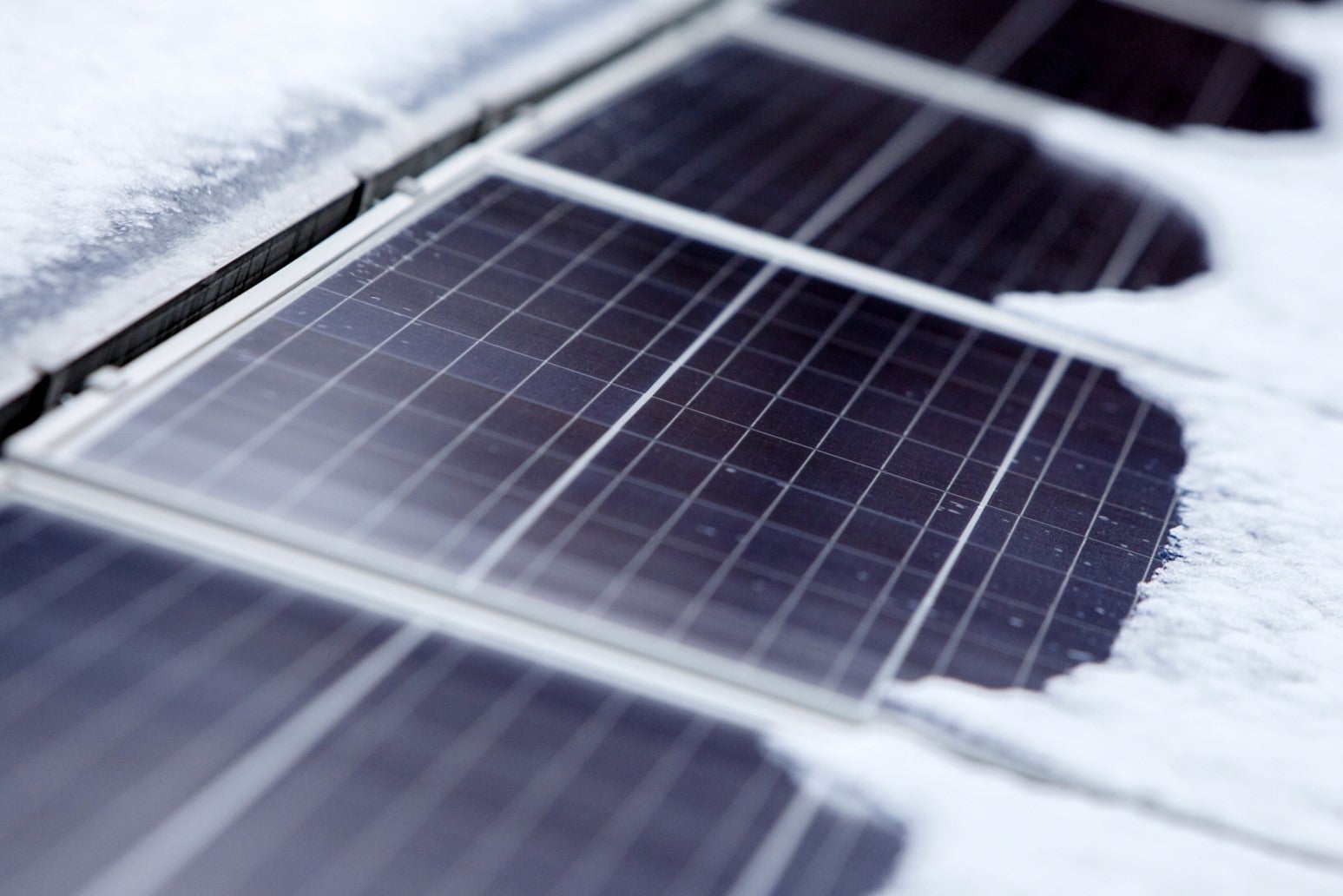
Yes, but this is where your expectations matter. Solar panels don’t need blazing sun to work. They generate electricity whenever there’s daylight, including on cloudy or rainy days. The trade-off is output: in heavy cloud, you’ll typically see significantly less generation than you would on a clear day.
On very overcast days, systems might produce around 10 to 25 per cent of what they’d generate in ideal conditions (the exact number depends on the density of cloud and the efficiency of your panels). Panels that use monocrystalline cells tend to perform better in low light. For more on this, see our guide to how solar panels work in winter and on cloudy days.
Winter performance
Winter reduces solar output because the days are shorter, and also because the sun sits lower in the sky, which means the light is less intense.
Even so, solar panels still generate power whenever daylight hits them, and cold temperatures can actually help efficiency slightly, because PV cells perform better in cooler conditions.
In the UK, you might expect output to drop to around 30-50 per cent of summer levels depending on location, roof angle and orientation.
What about at night?
Solar panels don’t generate electricity at night, because there’s no sunlight to convert. If you want to use your daytime generation after dark, you’ll need to store surplus electricity in a battery, or export it to the grid and offset costs through SEG payments, while still importing what you need overnight.
Do solar panels work in a heatwave?
They do, but there’s a slightly counterintuitive twist.
Solar panels love light, not heat. Hot weather can reduce solar panel efficiency because PV cells become less effective at converting light into electricity as their temperature rises.
Modern panels are designed with layers and insulation to help regulate internal temperature, but there’s still a point where heat starts to nudge performance down. The practical takeaway for UK homeowners is that during a heatwave, days are usually bright and long, so you can still generate a lot of power overall, even if the system is slightly less efficient at peak temperatures.
For more on this, see our guide to whether solar panels perform better in a heatwave.
Where can I install solar panels?
If you’re considering which may be the best solar panels for your home and trying to work out what’s realistic, where you can install them matters as much as the brand or model.
Most people picture solar panels on a pitched roof, and that’s still the most common setup. But you may have other options.
Pitched roofs
Installers usually aim for the section of roof that offers the best daylight exposure with the least shading. Panels can go on the front or back roof slope depending on orientation and obstructions.
Beyond the main roof
With the right mounting system (and any necessary permissions), solar panels can also be installed on flat roofs, garages and outbuildings, sheds, and gardens (ground-mounted systems).
Sometimes these alternatives make sense if your main roof isn’t suitable, or if you want more generation than your roof can physically accommodate.
Can I install solar panels on a flat roof?
Yes, solar panels can be installed on flat roofs, and it’s more common than people assume.
Flat-roof systems typically use angled frames so panels sit at a tilt that improves generation and helps rainwater run off. Depending on the roof type, the frames may be ballasted (weighted down) or mechanically fixed.
A flat roof install needs careful planning around roof strength and loading (including the weight of frames and ballast), wind uplift, shading from parapets or nearby buildings, and access for maintenance and safe walkways. A professional survey should assess these factors before any install is signed off.
Heat pumps explained: how they work and what they cost
How much do solar panels cost? UK 2026 prices guide
Best solar panels 2026 for UK homes, reviewed by experts
The truth about whether UK solar panels are worth it
How much do solar panels cost? UK 2026 prices guide
I’ve found the best solar panels for UK homes to save your time researching