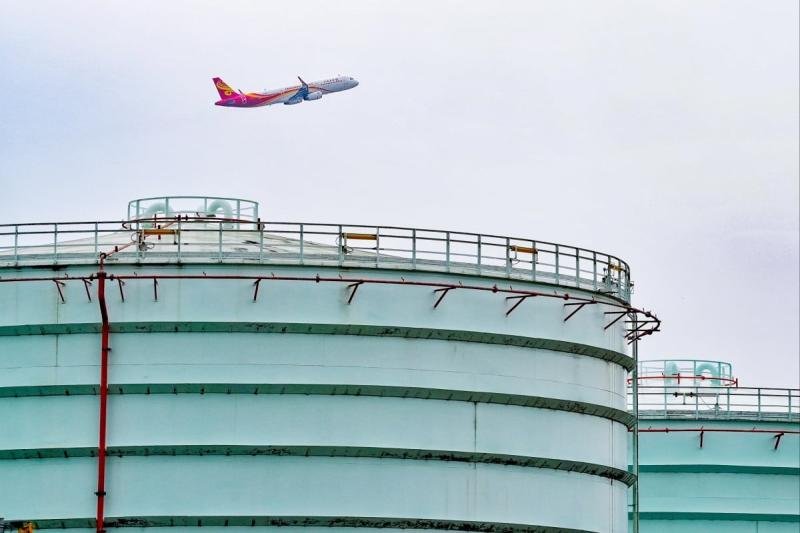
Hong Kong's airport is set for a shift in volume this summer after airlines quietly swapped jet sizes and reduced scheduled flights to manage costs amid a global fuel crisis and following a jump in economy passenger fares to Europe.
Some airlines told the South China Morning Post they would operate all scheduled flights beyond June after initial consolidation efforts to offset higher jet fuel prices triggered by the Middle Eastern war.
According to data from analytics company Cirium, the aviation industry managed disruptions through capacity changes made months in advance rather than opting for last-minute cancellations.
"The Gulf hubs - principally Dubai and Doha - act as the primary geographic bridges between Asia, Europe and Africa," independent aviation analyst Jason Li Hanming said.
"A sudden reduction in widebody capacity from these carriers removes the market's biggest supplies for long-haul travel."
Qatar Airways, for example, slashed the number of Boeing 777-300ER flights from Hong Kong to Doha slated for May, data showed.
In late February, the airline had scheduled 62 flights for May but had cut that figure to 17 by the end of April, a massive 72.5% reduction, according to the data.
The airline said it previously operated a once-a-day service between the cities while restoring its network after disruptions in late February. But it returned to two flights a day on May 19, matching service levels from before Feb 28.
Emirates reduced similar flights to Dubai by 48.3%, from 31 to 16 flights over the same scheduling period, data showed.
"Emirates is marking a near-full return to operations, with 96% of its global network now restored, following a period of disruption," the airline said in early May.
Emirates served 137 destinations with more than 1,300 weekly frequencies, representing 75% of pre-disruption capacity, the airline said.
But for Hong Kong, there were currently only two flights per day, according to the airport's website.
Early this month, Secretary for Transport and Logistics Mable Chan noted that the major aviation fuel price index in the Asia-Pacific region had more than doubled due to the war in the Middle East.
As of May 5, less than 5% of passenger flights had been cancelled for the month and June, while about 1% had been cancelled for July, she said.
An Airport Authority spokesman said on Friday that the facility had seen steady growth in air traffic in April, with most markets expanding except for the Middle East, which contracted.
The authority expected the momentum to continue into the summer peak travel season as it commissioned departure facilities at Terminal 2 to cater for growing demand, the spokesman added.
Data showed Hong Kong flag carrier Cathay Pacific Airways cut 137 flights in May. In February, the airline had scheduled 5,371 flights for May, but reduced the number to 5,234 in late April, a decrease of 2.55%. It also reduced its scheduled flights for June by 3.8%.
"Cathay Pacific has consolidated a small number of passenger flights between mid-May and the end of June, in response to the significant increase in jet fuel prices since the beginning of March due to the ongoing volatile situation in the Middle East," the airline said.
About 2% of the carrier's total frequencies during the period were cancelled, mostly involving regional services, Cathay said.
The airline previously said that, after June, it planned "to operate all our scheduled passenger flights, subject to developments in the Middle East situation and jet fuel prices in the coming months".
In two statements on May 20, Cathay said it would extend the suspension of all flights from Hong Kong to Riyadh and Doha to Aug 31.
Data showed the airline had cut its widebody Airbus A330-300 flights to Bangkok's Suvarnabhumi Airport for July, going from 174 originally scheduled in late February to 95 in late April - a 45.4% drop.
In July, Cathay increased its narrowbody Airbus A321neo flights to Suvarnabhumi Airport nearly three times, going from 28 to 109 over the same scheduling period, data showed.
"The trend of Cathay Pacific substituting widebody jets like A330s or 777s for narrowbody planes such as the A321neo on regional routes like Bangkok is a classic yield management strategy," Li said.
To accommodate sudden changes in aircraft sizes and shifting flight frequencies, the Airport Authority adopted a flexible approach in allocating stands and coordinating with airlines to align fleet mixes with flight schedules, the spokesman said.
Cathay's budget arm, HK Express, cut 163 flights, or 8.3%, for June and removed more than 35,000 seats, or 8.1%, across the late February to late April scheduling period, data showed.
"HK Express has consolidated a small number of passenger flights between mid-May and the end of June in response to the significant increase in jet fuel prices since the beginning of March due to the ongoing volatile situation in the Middle East," the airline said.
"Jet fuel prices remain at highly elevated levels, and this is placing significant cost pressure on airlines around the world."
About 9% of its total frequencies during the period were cancelled, but the carrier planned to operate all its scheduled flights currently on sale beyond June, HK Express added.
Analyst Li said that when resources such as airspace, aircraft and crew became constrained, parent companies would "instinctively protect their high-yield, mainline operations".
"Low-margin, point-to-point budget routes are the first to be sacrificed to ensure the core network remains intact," he said.
Hong Kong-based Greater Bay Airlines (GBA) capitalised on the capacity vacuum by adding 21 Boeing 737 flights to Japan's Fukuoka in July, marking a 67.7% increase from the 31 flights in the late-February schedule to 52 in the late-April schedule, data showed.
"To meet travellers' demand this summer, GBA will introduce seasonal services to numerous destinations such as the Maldives, Phuket and Da Nang," it said.
The carrier would offer a new route to Indonesia's Surabaya starting on Sept 23 and enhance services on selected existing routes, it added.
The Airport Authority introduced an air network development programme in 2024 to provide financial incentives to airlines launching flights to new destinations connecting Hong Kong airport.
The initiative attracted more than 30 airlines and added 89 new destinations to its global network, its spokesman noted.
Data showed China Eastern Airlines reduced May flights between Hong Kong and Shanghai Pudong International Airport on Airbus A320s from an initial 212 scheduled in late Feb to 23 scheduled in late April, representing an 89.2% drop.
"You can expect severe upwards pressure on direct fares, likely resulting in premium cabin sell-outs and economy tickets jumping by anywhere from 20% to 50% during the summer peak," Li said.
Cathay made no reductions to its direct route to London's Heathrow Airport over the period checked, maintaining 100% of its scheduled flights for May, June and July, data showed.
"Cathay is protecting its highly lucrative long-haul network - where demand is surging due to the Gulf carrier cuts - by reallocating its largest aircraft to those routes," Li said.
Economy class fares from the city to London jumped by 17 % from US$528 in January 2024 to US$618 in January, before falling by 15.9% to US$520 in February, data showed. The fares excluded taxes and fees and were not adjusted for inflation.
"Airlines operating direct routes to Europe - such as Cathay Pacific and British Airways to London Heathrow - suddenly see a shrinkage of connecting competitors that arrange passengers [to] connect through their Middle East hub on an artificially scarce resource," Li said.
Economy class tickets from the city to Paris jumped by 20.8% from US$648 in January 2024 to US$783 in January 2026, data showed.