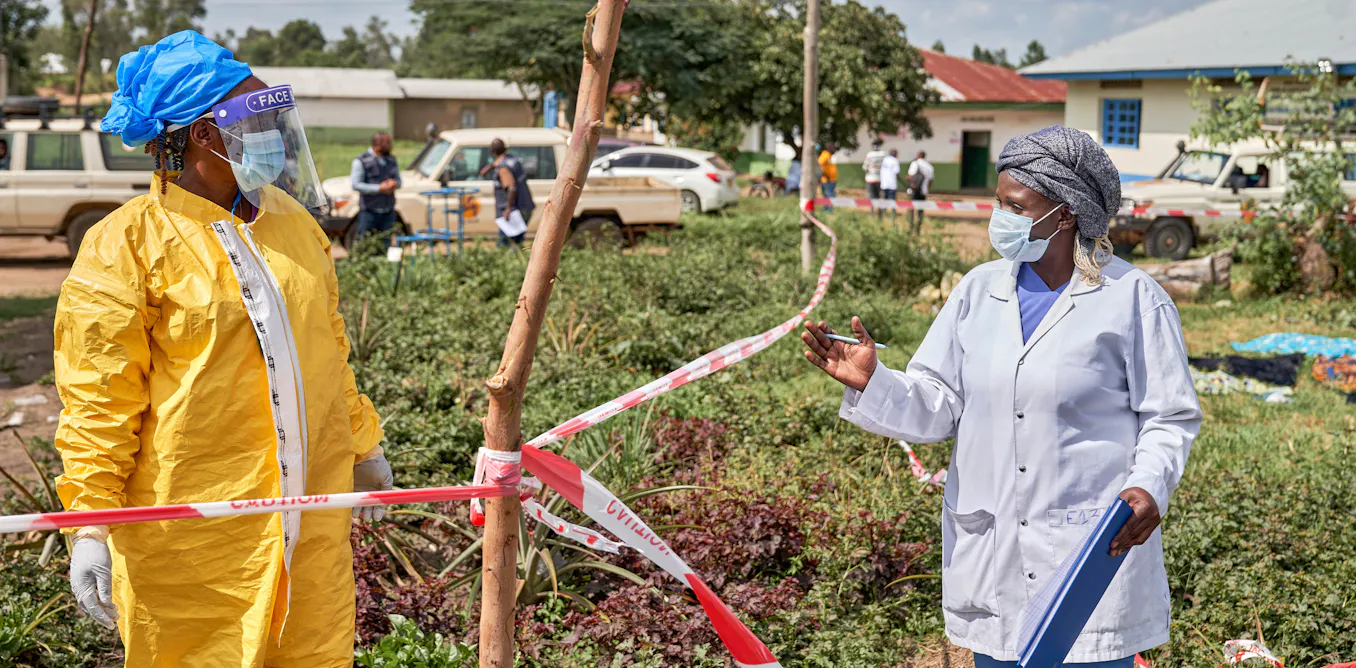
The Democratic Republic of Congo (DRC) is grappling with a rising Ebola epidemic, with almost 600 cases detected so far and more than 130 deaths.
Ebola is a rare virus that initially causes a fever, fatigue, muscle pain, then vomiting and diarrhoea. It can then progress to the hemorrhagic stage, with internal bleeding – which presents as blood in vomit and faeces – as well as bleeding as from parts of the body including the nose, gums, vagina and needle punctures.
Ebola primarily spreads through contact with bodily fluids such as blood, faeces and vomit. It can be contracted from contaminated surfaces or contact with bodies of those who have died, but can also spread by other routes including without contact.
This current outbreak, caused by the rare Bundibugyo strain, was first confirmed as Ebola on May 15. It was already estimated to have 246 cases at the time of this confirmation.
As surveillance efforts stepped up, it became clear the outbreak was more than double that size, with spread to Uganda.
So what are health authorities doing to get the virus under control and why is it such a challenge?
And what can health authorities in Africa, as well as the rest of the world, learn from previous outbreaks?
How did so many people get sick so quickly?
Ebola has a long incubation period of two to three weeks or longer. This means the number of infected people has likely been growing since at least March or April.
Our epidemic early warning system, Epiwatch, saw signals of unknown illness in the DRC on April 13, with reports of hemorrhagic fever noted even earlier on March 13.
The delay in diagnosing Ebola may have been due to initial testing targeting the more common Zaire strain of Ebola. Tests must be specific to Bundibugyo.
The DRC is also experiencing other serious outbreaks including mpox and measles, as well as malnutrition and chronic malaria.
These underlying factors can make epidemics more severe and harder to detect.
Read more: WHO has declared mpox a global health emergency. What happens next?
How big did previous outbreaks get?
The worst Ebola epidemic in history was over 28,000 cases in the 2014 West African epidemic. More than 11,000 people died from this Zaire strain, as vaccines were not yet available at the peak of the epidemic.
In the DRC, the last epidemic of 64 cases was in late 2025. The largest epidemic in the DRC was in 2018-2019 with more than 3,000 cases. These were both the Zaire strain.
There have only been two other Bundibugyo outbreaks. The first, in 2007 with 149 cases, was in the Bundibugyo District of western Uganda, near the DRC border. The second, in 2012, was in the DRC, with 57 cases. The current Bundibugyo epidemic is already the largest in history.
While Bundibugyo is not as lethal as the Zaire strain, it can kill 30–50% of infected people. The fatality rate in this epidemic appears close to 30%, with 139 deaths reported from almost 600 cases.
Unlike the Zaire strain, for which there are treatments and vaccines, there are no approved drugs or vaccines for the Bundibugyo strain.
However, the World Health Organization has sponsored clinical trials of a monoclonal antibody and the antiviral remdesivir, a drug which is also used for COVID.
We may see higher fatality rates unless non-pharmaceutical measures ramp up.
How can it be stopped?
The epidemic can be stopped by coordinated surveillance and containment. This is by identifying cases, isolating them so they cannot infect others, tracing their contacts and quarantining them.
In 2014, these measures alone controlled the Ebola epidemic at a time when no treatments or vaccines were available. This means health system capacity is the key to epidemic control.
There were not enough beds for Ebola patients in the 2014 epidemic, so health authorities built tent hospitals to help bring the epidemic under control. This could be considered if hospitals are overwhelmed.
The DRC has limited capacity to diagnose Ebola, so it’s important to scale up surveillance and testing. A clinical case definition (such as “fever and bleeding means a probable case”) can be used if testing is not available.
Simple surveillance systems – such as open-source intelligence, where community chatter and local news reports can provide signals of epidemics – can help. So can providing incentives for communities to report suspected cases.
It’s also essential to communicate and work with communities and community leaders from the ground up. In the 2014 epidemic, locals murdered eight Ebola workers who provided health education, showing how important trust and community relationships are.
Health workers, close contacts and funeral attendants need extra precautions
Ebola is predominantly spread by contact with blood and bodily fluids. Those most at risk are close contacts of patients with Ebola, health workers and people attending funerals, which often involves touching the body.
At least four health workers have been infected, including one American missionary doctor.
Given the high fatality rate, health workers should be provided the highest level of personal protection.
Read more: How are nurses becoming infected with Ebola?
What can other countries do?
Ebola is a concern for all of us, because travel can result in infections occurring in any country. During the 2014 West African epidemic, cases also occurred outside the main affected countries, the largest number in Nigeria.
Failure to initially diagnose a case in Texas resulted in four other people becoming infected, including health workers.
Whether facing hantavirus or Ebola, emergency departments need tools to improve their awareness of and ability to prevent hospital outbreaks.
Busy staff in emergency triage may send someone with a fever back to the waiting room for hours, not realising they have travelled recently and may have a serious infectious disease. In South Korea, a person with the deadly Middle Eastern Respiratory Syndrome (MERS) virus was in the emergency department for many hours, and a huge outbreak resulted.
One useful tool for hospitals is a decision-support system used during triage that prompts staff to ask for a patient’s travel history and provides data on disease outbreaks in the country of travel. This means patients with deadly infections may be isolated before they can infect others.
Another concern is that if the outbreak becomes much larger, there may be survivors who still harbour the virus for many months or longer after recovery. They could continue to infect others after this epidemic is over if they come into contact with bodily fluids such as semen, amniotic fluid or breast milk, as well as fluids from the placenta or eye.
The WHO declaring a public health emergency of international concern helps, as it activates a range of additional measures and resources for outbreak control.
Read more: Ebola survivors struggle to return to normal lives: what I found out in Sierra Leone and Liberia
This article was originally published on The Conversation. Read the original article.