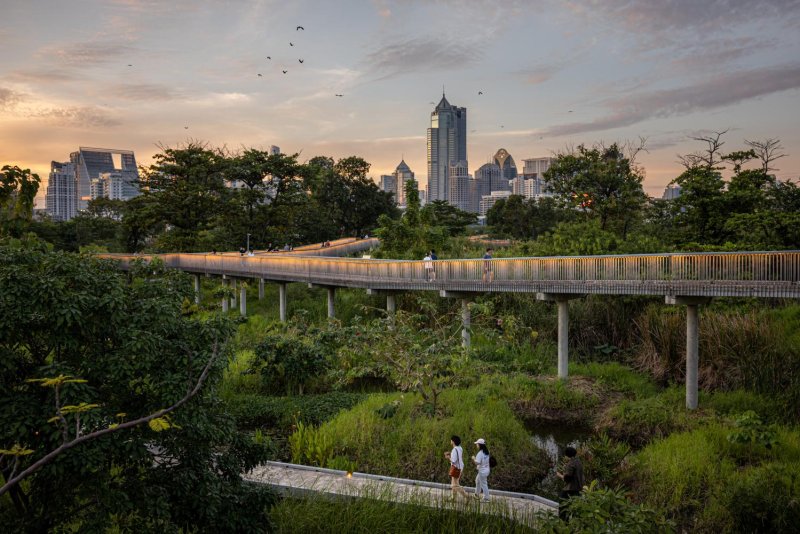
At our recent annual summit on Building Resilience held in Bangkok, I sat across the table from smart people making familiar arguments. The cost is too high. The market is not ready. The supply chain cannot support it. There is no regulation forcing the issue. I have been hearing these arguments for 15 years working in this green building auditing profession. And every year, they become a little harder to defend with a straight face.
The question was framed as a debate. The question is not whether sustainable construction is optional. The question is who still pretend to take sustainability as optional, and for how long.
The cost argument: who pays and who decides?
This was the loudest argument in the room. It always is. And there is nothing wrong with this argument; it is just incomplete.
In our experience across certified projects in Thailand, the upfront cost premium for sustainable construction is less than one percent. That is less than a typical contingency budget line. So, the idea that sustainability is a luxury add-on that breaks project, not supported by what we actually see on real project budgets.
The issue is that cost conversation in this industry almost focuses on upfront construction cost. It never includes lifecycle cost, operational savings, risk-adjusted asset value, or the cost of doing nothing. For examples, energy efficiency measures in Thai commercial buildings can pay back within 3 to 5 years.
According to recent research Will Green Certification Secure Bangkok Office Demand? by JLL Asia Pacific Research, prime green-certified buildings command a 37 percent gross rent premium over the market average in the central business district (CBD) zone in Bangkok in 2024. In the third quatre of 2025, green-certified buildings absorbed over 92,000 square metres of net demand while non-green spaces contracted by 11,000 square metres.
And then there is the cost that rarely appears in budgets: future adaptation. Designed and built today, these buildings have to cope with environment in 2050. Along the way, these structures will also face with external pressure.
For example, Bangkok is sinking by up to two centimetres per year, sits at an average elevation of 1.5 metres above sea level, and the 2011 epic flood and subsequent annual floods caused damage to the structure.
If not enough, heat stress is accelerating, and coastal assets face rising insurance costs and, in some cases, insurability risks driven by location and design.
Retrofitting for climate resilience is more expensive than designing for it from the start, meaning developers who skip it today are effectively deferring unavoidable costs into the future.
World not waiting for Thailand
The international regulatory environment is converging on mandatory sustainability faster than many developers realise. The EU Corporate Sustainability Reporting Directive, in force since 2023, requires companies to disclose the sustainability performance of their real estate, which is affecting Thai landlords with European tenants.
Global insurers are withdrawing from or applying significant premiums to climate-exposed assets: coastal properties, flood-prone locations, extreme heat zones. Thailand has all three. As insurance becomes unavailable or prohibitively expensive for non-resilient assets, the business model for conventional construction in vulnerable locations does not just suffer, it breaks.
Not because of regulation but because of market does not offer required insurance policies.
Thai law is starting to move
The Climate Change Act, which will establish carbon pricing, an emissions trading scheme, mandatory reporting, and a carbon tax, is on track to take effect as early as 2027. So, anyone treating the Climate Change Act as a distant abstraction is making a financial bet against Thai policy direction.
What has already lost the optionality argument?
Grade A office space in Bangkok -- the debate is over. International tenant requirements and Environmental, Social and Governance (ESG) procurement standards are reshaping the sector. The conversation is now centred on climate resilience.
Hospitality: the most physically exposed sector, yet still uneven in response. International brands have committed to ESG and sustainable design and construction, while Thai-owned and independent hotels skip it and remain the most vulnerable to climate and insurance risk.
Industrial: the fastest-growing sector and increasingly shaped by multinational tenant requirements. Gaps in sustainable industrial supply are already costing Thailand investment to regional competitors moving faster on green standards.
Mid-market residential: where cost pressures are most real and it is where incentives to invest in green infrastructure are not viable.
But it is also where the highest volume is being built, locking in future retrofit costs without adapted policy and financing support.
Where is our professional integrity? The buildings and construction sector accounts for 34 percent of global energy-related CO₂ emissions. Thailand is in the middle of one of the region's most significant construction booms.
The decisions being made right now, by investors, developers, consultants, architects, engineers, and lenders, will lock in emissions and climate vulnerability for the next half century.
Every time our industry decides that sustainability is optional, it is making an active choice with compounding consequences.
The window for that conversation is closing. The question is whether we use the time we have left to act or to argue about whether action is necessary while facing the inevitable consequences of climate risk.
Armelle Le Bihan is CEO of GBCE (Green Building Consulting and Engineering).