
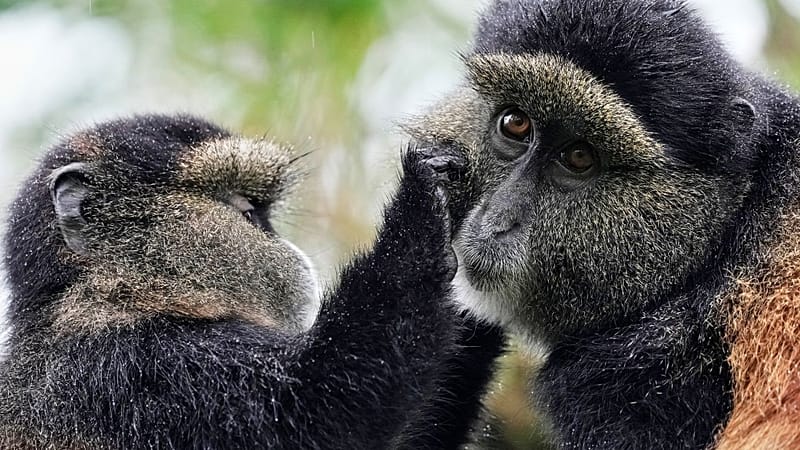
Scientists in Rwanda's misty Volcanoes National Park are turning to a new tool to protect endangered mountain gorillas and golden monkeys: environmental DNA.
Known as eDNA, the technology identifies species using genetic traces – fur, faeces – left in soil and water, eliminating the need for researchers to physically locate the animals.
Samples collected from downstream ponds can reveal which species live on higher ground.
"With one kit, you can assess multiple species, amphibians, mammals, birds and many others which cannot be detected using traditional techniques," says Deogratias Tuyisingize of the Dian Fossey Gorilla Fund.
The African Wildlife Foundation introduced the technology in partnership with the Rwandan government, aiming to build a complete picture of the country's biodiversity threatened by climate change and population growth.
It's particularly useful in rugged, insecure border terrain where ranger movement is limited.
But eDNA has limits. It can't estimate how many animals are present at a given time, as DNA can linger after a species has left, while Africa's genetic reference libraries remain thin compared to those in Europe and America.
Researchers are now building region-specific databases and training local communities to collect samples, a step toward making the technology work for Africa, not just in it.