Microsoft Build is the company's annual developer conference, running every year since 2011. This year, it has a clear organizing theme: AI agents. Scheduled for June 2 and 3 at Fort Mason Center in San Francisco, it's the first time Build has left Seattle since 2016.
Microsoft has kept in-person attendance to around 2,500 developers, with Satya Nadella delivering an opening keynote framed around "creating new opportunities for developers across our platforms in this era of AI." With a smaller attendance capacity and tight event schedule, Microsoft is hoping to make this the defining event for its AI-native products.
Last year, Microsoft Build produced more than 50 announcements across GitHub Copilot, Azure AI Foundry, and the Model Context Protocol (MCP), establishing autonomous coding agents and multi-agent orchestration as the central developer story. A year on, much of that tooling has graduated from preview to production. Build 2026 is expected to show where it goes next.
AI-native programming at Build 2026: What to expect
Microsoft has organized the Build 2026 session catalog across seven tracks, with Agents & Apps, GitHub, and developer productivity at the top of the agenda. Developer tooling announcements are expected to reflect the company's central framing for the event: 'agents.'
GitHub Copilot's autonomous coding agent, first announced at Build 2025, has had a year in real-world deployments. The agent can pick up a GitHub Issue, spin up an isolated environment through GitHub Actions, work through the task, and open a pull request for human review. Build 2026 is expected to show the next generation of that capability, including multi-agent coding workflows and deeper integration between GitHub and Azure services.
On the platform side, Azure AI Foundry is likely to receive significant additions. Microsoft Agent Framework 1.0 reached general availability in April 2026, giving .NET and Python developers a production-ready SDK for multi-agent orchestration. Sessions at Build are expected to show how that framework connects to Foundry's agent runtime, managed memory, and observability tooling at scale.
Microsoft has also been pushing AI capabilities to the device layer. Windows AI PCs carrying Qualcomm Snapdragon X Elite, Intel Core Ultra, and AMD Ryzen AI processors have been on the market for two years. The developer tooling is finally matching the hardware. Build sessions are expected to cover Windows Copilot Runtime APIs that target on-device NPUs, enabling a hybrid architecture where simpler inference tasks run locally and complex ones go to the cloud.
What ties these announcements together is a shared direction. You describe what you want, agents handle the execution, and the developer's role shifts toward directing and reviewing rather than writing every line. Whether that model holds up in production across complex workloads is a central question Build 2026 is expected to start answering.
What is intent-first programming?
The phrase "intent-first programming" describes a model where you express what you want a system to do, rather than writing the instructions for how to do it. Where traditional development requires authoring explicit syntax and logic, intent-first tools accept natural language descriptions and translate them into working code. That translation layer is now embedded in GitHub Copilot Agent Mode, the Copilot Studio Agentic Workflow Builder (which reached general availability on May 20, 2026), and GitHub Spark.
For you as a developer, this changes the nature of the work in specific ways. You spend less time writing boilerplate and more time reviewing, redirecting, and validating what the agent produces. Writing a precise prompt that accurately conveys scope and constraints becomes at least as important as syntax proficiency, while interpreting and auditing generated code still requires solid technical understanding.
The risks that come with this model are real and worth naming. AI-generated code can carry security vulnerabilities, performance inefficiencies, and subtle logic errors that pass visual inspection. Cybersecurity researchers have documented these problems across multiple vibe coding and AI-assisted development platforms. Intent-first programming accelerates the path from idea to running code, but it doesn't remove the need for a technically informed person in the loop.
What’s the difference between code-first and intent-first?
Dimension |
Code-first |
Intent-first |
Primary input |
Explicit syntax written by the developer |
Natural language description of the desired outcome |
Developer role |
Author of implementation |
Director of outcomes and reviewer of generated code |
Error handling |
Developer debugs manually |
Agent iterates and self-corrects, with developer oversight |
Skill emphasis |
Language and syntax proficiency |
Prompting precision and code review |
Speed |
Slower for routine tasks |
Faster for common patterns; slower for complex edge cases |
Output accountability |
Developer owns every line |
AI produces the code; developer remains responsible for it |
Everything we know of Microsoft's plans for AI at Build
Microsoft has been laying this groundwork in public across 2025 and early 2026. The tools arriving at Build 2026 aren't appearing from scratch; they've been maturing through preview cycles, with Build serving as the venue where Microsoft maps out how they fit together as a production stack.
Enterprise demand has also moved in this direction. A PwC study cited by Microsoft found that eight in ten enterprises now use some form of agent-based AI. Appetite for tooling that handles entire workflows, not just isolated code suggestions, has grown accordingly.
Agent Mode on GitHub Copilot
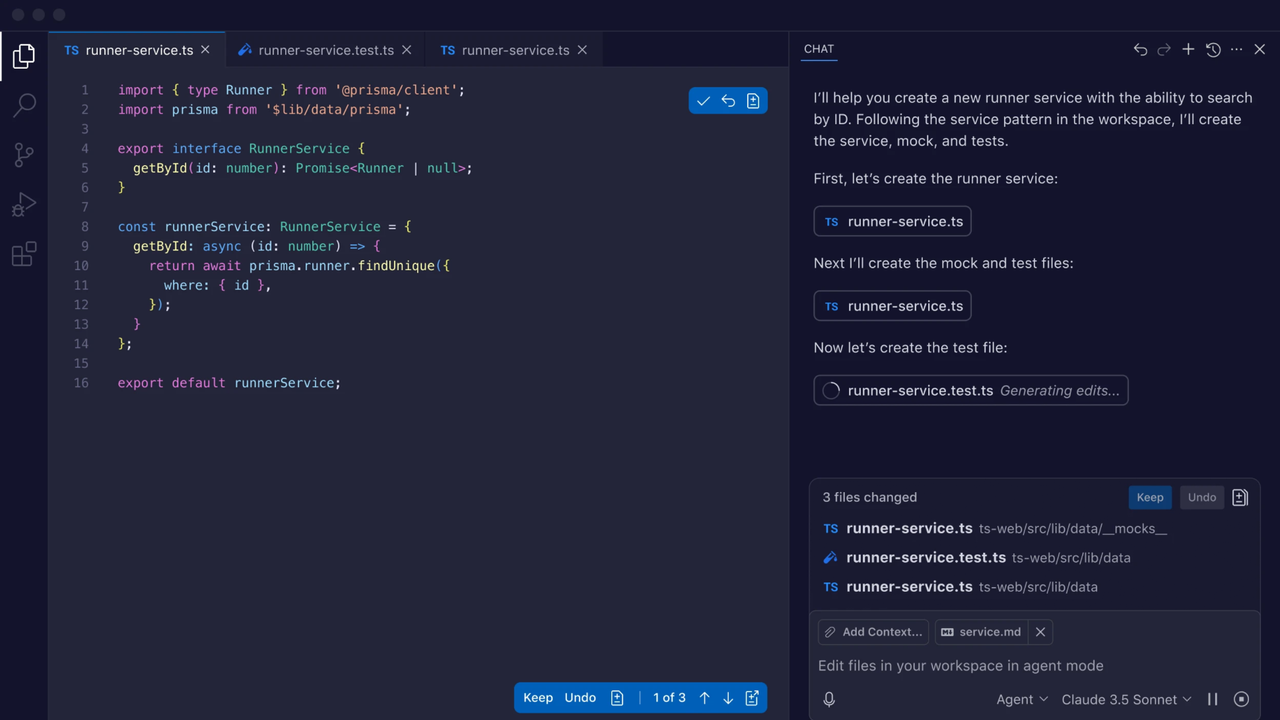
GitHub Copilot Agent Mode is now generally available and built directly into Visual Studio Code. In agent mode, you describe a task in natural language. Copilot then plans the approach, edits files across your codebase, runs terminal commands with your explicit approval, and iterates until the result matches your specification. The system supports third-party agents from providers including Anthropic and OpenAI alongside Copilot's own built-in agents.
The asynchronous coding agent adds another layer on top.
You assign a GitHub Issue to the agent. It spins up an isolated environment through GitHub Actions, works through the task in the background, and files a pull request for you to review when it's done. This capability is available on Pro, Pro+, Business, and Enterprise Copilot plans.
Build 2026 is expected to show what's next for these agents, including multi-agent coding workflows inside VS Code.
GitHub Spark , NLP, and semantic code search
GitHub Spark is a natural language app builder that lets you describe an application in plain English and receive working code with a live preview. Currently available to Pro+ and Enterprise subscribers, it's Microsoft's most direct response to dedicated vibe coding platforms. Build 2026 is a likely venue for updates on Spark's broader availability and expanded capabilities.
Semantic code search, also introduced in 2026, works on a different principle. Rather than matching keywords, it uses embeddings that understand code intent: searching for a "login bug" can surface authentication middleware and session handling logic even if those files never use the word "login." Together, Spark and semantic search point toward a development environment that understands what you mean, not just what you type.
Azure AI Foundry and Microsoft Agent Framework
Azure AI Foundry, which replaced Azure AI Studio in November 2024, has expanded steadily into a unified platform for building AI applications. The February 2026 update introduced multi-agent orchestration, MCP support, hosted agents, and sovereign local deployment options. Developers can now define agents in YAML, run two CLI commands, and have Foundry provision compute, register endpoints, and return a production-ready URL.
Microsoft Agent Framework 1.0 reaching general availability in April 2026 gave .NET and Python developers a commercial-grade SDK that converges two former research projects, AutoGen and Semantic Kernel, into a single runtime. Build 2026 is expected to detail how teams can use Agent Framework to connect Foundry agents, Microsoft 365 Copilot, and external tools through standardized A2A and MCP interfaces, moving multi-agent systems from experimental territory into enterprise operations.
Windows Copilot Runtime for on-device inference
Windows Copilot Runtime provides APIs that route AI inference to the NPU in AI-capable Windows machines. Build sessions are expected to cover new capabilities within the Windows App SDK, including Vision, Language, and Speech models that run entirely offline. For you as a Windows developer, this matters because it changes what's architecturally feasible without cloud connectivity.
Microsoft is also expected to announce an "AI Foundry for Windows" SDK that bundles ONNX Runtime, DirectML, and the Copilot Runtime into a single NuGet package. That would simplify on-device AI integration considerably, removing the need to wire together separate components.
The Windows Agent Arena developer sandbox, first announced at Ignite 2025, is also expected to get its first public workshop at Build.
What you should be thinking about as a developer
The shift toward intent-first tooling doesn't mean you can step back from understanding the code. If anything, your judgment becomes more consequential, because you're now the final check on a system that can produce hundreds of lines of plausible-looking code in seconds. Knowing when generated code is correct, when it's fragile, and when it introduces risk still requires technical depth.
Prompt quality matters more than most developers currently expect. Agents interpret ambiguous instructions literally or fill gaps with assumptions. Those assumptions may not match your production environment. Writing specifications that are clear about scope, constraints, and edge cases is a skill worth developing deliberately before agent-based workflows become the default on your team.
More than anything, though, the security review is a necessary step we'd urge you not to skip. Research from cybersecurity firms has documented critical vulnerabilities in AI-generated code across multiple platforms, from authentication bypass flaws to exposed environment variables. Build 2026 has a dedicated Responsible AI track and the compliance and safety tooling arriving through Foundry and GitHub suggests Microsoft is aware that this remains an open problem.
For now, treating generated code with the same scrutiny you'd apply to a pull request from a junior developer is a reasonable baseline until these tools mature further.






.png?w=600)