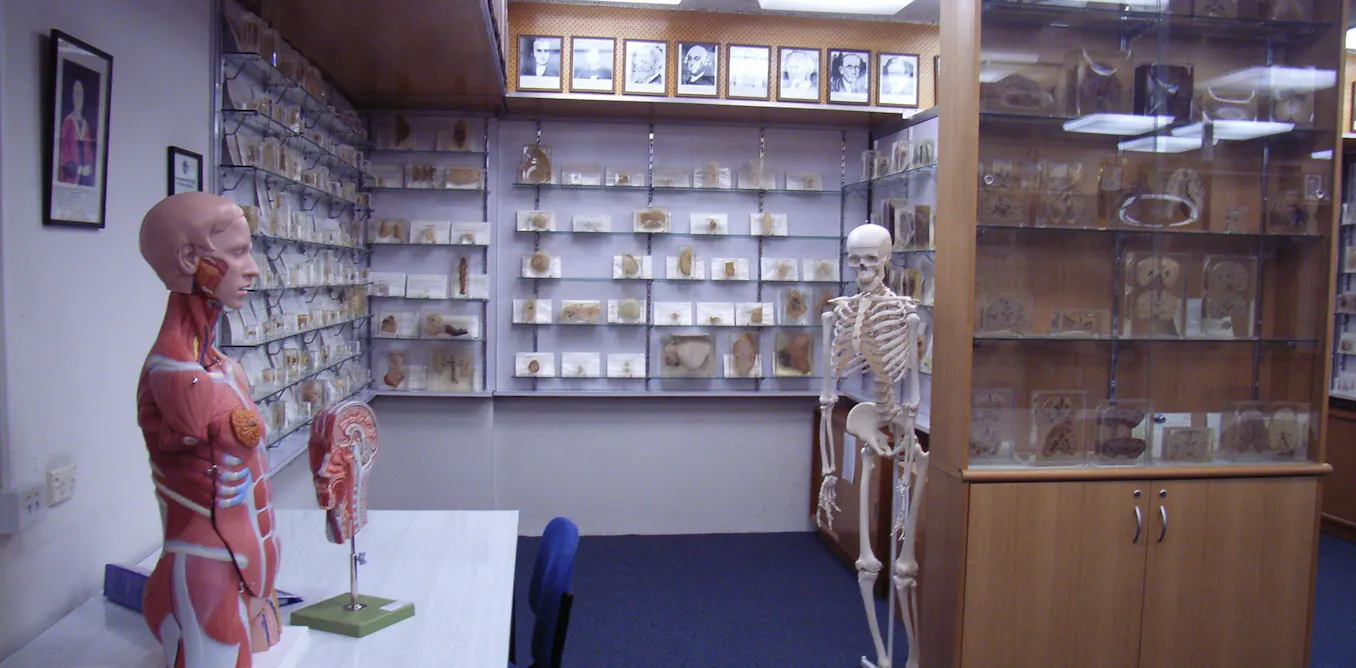
The RA Rodda Pathology Museum at the University of Tasmania, established in 1966, is currently in possession of about 2,700 human body parts. At least 177 of these were obtained without consent from their loved ones.
Most of these human bodies were collected from individuals who, at the time of their death, required an autopsy. A coroner’s investigation found that, between 1966 and 1991, forensic and hospital pathologists employed by Tasmania’s Department of Health stole these human organs and tissues.
At no point were the families of the individuals contacted for their consent.
This week, Tasmania’s health minister Bridget Archer delivered an apology to the loved ones of the individuals on display. In the audience were people who had lost family members as long ago as 1976, but who were not informed of the display until 2025.
The incident points to a broader issue with how human remains have historically been collected, stored and displayed in Australian institutions.
Stolen bodies, silent museums
Institutional audits in 2023 and 2024 found that, combined, more than 600 ancestral remains from the Pacific region were being stored in the Queensland Museum, the National Museum of Australia, and the Australian Museum. Some of these had been stored in the museums since 1862. More museums in Australia are likely also storing ancestral remains.
These remains include brains, skulls and children’s bones. They were likely obtained during the boom of human remains trading in the late 19th and early 20th centuries.
In this trade, Indigenous remains would be collected, often from colonised land, and provided to European academics. This trade was rooted in racism, phrenology (an often racist pseudo-science that argued traits of the skull could be interpreted to infer a person’s personality), and anthropology.
It’s not just museums. Throughout Australian universities are collections of bones with unknown histories. Many likely came from India, the world’s largest exporter of human remains up until 1985 – a trade established under British colonial rule. These remains were often stolen from graves.
How can museums be more transparent?
Some museums in Australia have taken the initiative to return ancestral remains to loved ones and their communities. This is known as “repatriation”.
Last year, the British Natural History Museum repatriated the remains of 36 First Nations people.
Between 1985 and 2016, Museums Victoria repatriated more than 2,200 individuals to Indigenous communities in Australia and New Zealand.
Similarly, the Queensland Museum, the National Museum of Australia, and the Australian Museum have established programs to return ancestral remains to Country.
The South Australian Museum states they currently “care for almost 5,000 ancestral remains” from both First Nations peoples and overseas Indigenous populations. These remains are kept – until returned to their respective Country and resting place – in a secure, temporary Keeping Place. This is a culturally appropriate resting ground that is highly restricted and separate to other displays.
Body parts displayed at the Rodda Museum were removed from public viewing in 2018. From the 177 body parts stolen from autopsies, 100 individuals were identified and their families were contacted.
All remains were disposed of, with the family’s knowledge and, where possible, in accordance with their wishes. Unidentified remains were respectfully disposed of in accordance with the law.
A macabre fascination
Many museums around the world participate in the display of human remains. From Egyptian mummies in the British Museum, to the display of a murderer’s skeleton at the University of Edinburgh’s Anatomical Museum, people are fascinated by these macabre displays.
Globally, millions of people have attended the touring Body Worlds exhibition. This exhibit uses the plastination (a process to preserve biological tissue) of real bodies to offer a close look at human anatomy, physiology and movement.
All of the humans displayed provided their consent to be included by bequeathing their remains prior to their death.
A copy-cat exhibition known as “Real Bodies” was set up in Sydney in 2018. However, it faced significant backlash, as the 20 bodies it used were classified as “unclaimed corpses” from a medical university in China. As at the Rodda Museum, consent was not provided by the individual, nor their loves ones.
The specific laws relating to the display of human remains at museums and universities vary between each state and territory. However, obtaining consent from the individual during their lifetime is fundamental.
Consent can also include completing a burial warrant with the family, wherein donated body parts are returned to the family for proper burial after their use.
The right to rest and respect
Museums holding human remains of any kind have a responsibility to regularly audit their collections.
Those who identify they are storing remains obtained without consent should seek advice from the appropriate cultural community about repatriation – or should place the remains in a culturally safe environment until the custodians are identified.
Any evidence of unethical collection, storage or display must also be disclosed to impacted communities. It’s not a simple task, but it is an important one.
Repatriating remains allows for individuals to be buried in a manner that respects their cultural and religious beliefs.
The harm caused to the communities of individuals displayed without consent can never be undone. But recognising this wrongdoing, and making a genuine effort towards repatriation, will finally allow the living to respectfully lay their loved ones to rest.
This article was originally published on The Conversation. Read the original article.