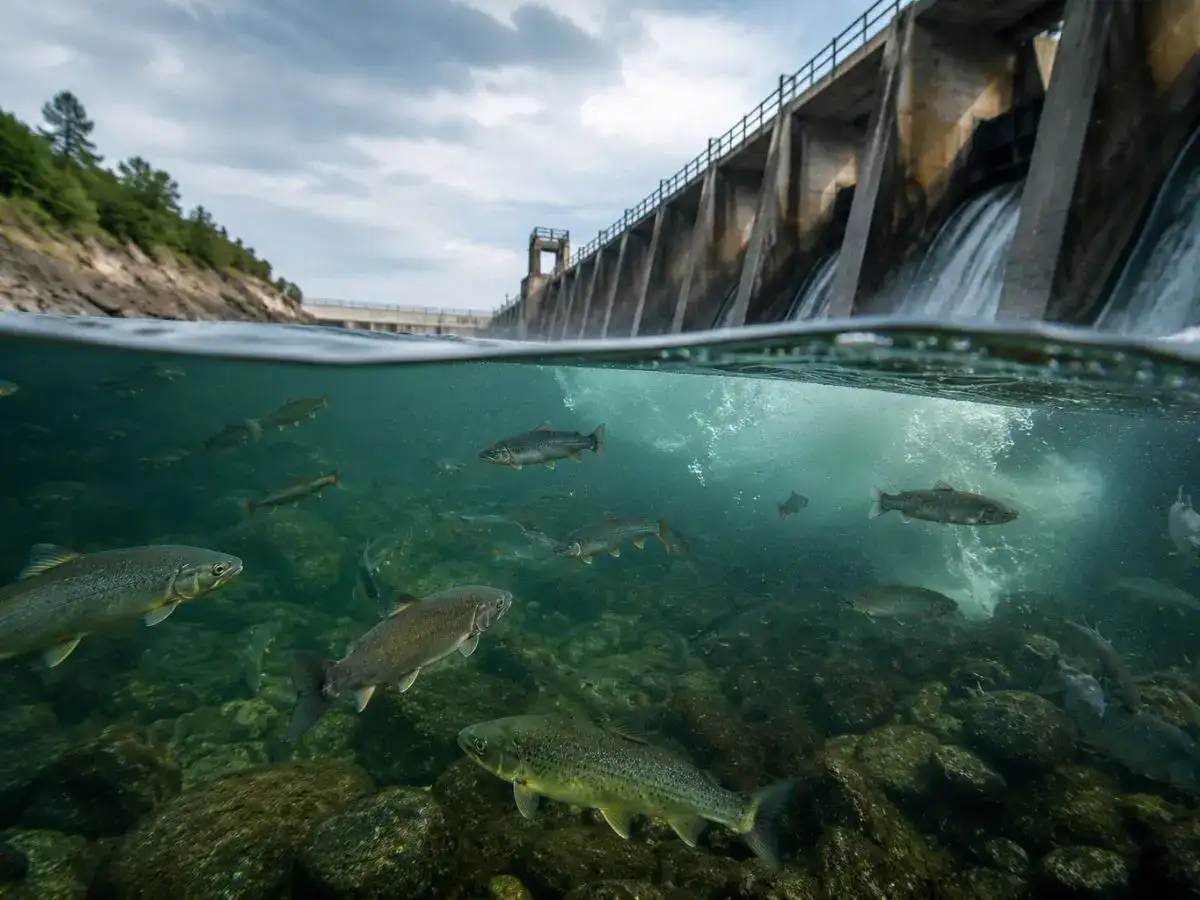
River restoration has long followed a simple idea: reconnect fragmented waterways, improve habitat conditions and bring rivers closer to their natural state. The assumption has been that healthier rivers will naturally support healthier fish populations.
But researchers behind the study "Eco-Evo-Hydraulics: Integrating Fish Evolution Into Ecohydraulics for Conservation", quoted by TOI, argue that this picture may be incomplete.
Many rivers have spent decades — and in some cases centuries — under the influence of dams, water regulation and engineered channels. Fish living in those waters have experienced environmental conditions very different from those faced by earlier generations.
The study suggests that some fish populations are not simply living with these changes. They may be adapting to them.
How quickly can fish adapt to changing rivers?
Evolution is often thought of as a process that unfolds over thousands of years.
Yet the review highlights growing evidence that freshwater fish can respond much faster when environmental pressures are strong enough.
One example comes from Norway, where Atlantic salmon experienced a significant reduction in body size over roughly three decades after river regulation altered their environment. Researchers identified genetic changes linked to that shift.
In the United States, blacktail shiners also showed measurable changes in body shape after dam construction transformed their habitat.
These examples suggest that altered rivers can influence which traits become more common within fish populations over time.
Rather than simply enduring new conditions, some fish appear to be adjusting to them.
Why might restoring rivers no longer be enough?
Conservation projects have traditionally focused on habitat improvements.
Creating fish passages, restoring natural flow patterns and improving spawning grounds have remained central goals for river managers.
The researchers argue that this approach becomes more complicated when rivers continue to face multiple pressures, including climate change, water extraction and ongoing infrastructure development.
In many places, there may no longer be a clear path back to historical river conditions.
The study suggests conservation efforts should also consider whether fish populations have the genetic diversity and adaptive capacity needed to handle future environmental changes.
In other words, restoring rivers may remain important, but understanding how fish are evolving could become equally important.
How do dams influence fish genetics?
The physical effects of dams and barriers are well known. They can interrupt migration routes, alter water flow and reshape habitats.
The study points to another consequence that receives less attention.
When fish populations become separated by barriers, gene flow between groups can decline. Over time, isolated populations may become genetically distinct.
Traits that help fish succeed in regulated or fragmented environments can become more common, gradually influencing how populations develop across generations.
This means infrastructure can affect not only where fish live, but also how they evolve.
Can fish change rivers too?
One of the more intriguing ideas explored in the review is that the relationship works both ways.
Rivers influence fish, but fish can also influence rivers.
Some species actively reshape river environments while feeding or reproducing. Salmon, for example, move gravel while building spawning nests.
The researchers note that the amount of sediment fish can move is linked to body size.
If environmental changes favour smaller fish over time, that could eventually alter how sediment is redistributed within river systems.
The study describes these interactions as "hydro-evolutionary feedbacks" — a process where environmental change influences evolution, and evolutionary change in turn affects the environment.
What could the future of river conservation look like?
The researchers are not arguing against restoration.
Instead, they suggest broadening how restoration is approached.
Habitat improvements may need to be paired with genetic monitoring and a deeper understanding of evolutionary change.
Tracking genetic diversity could help scientists identify populations that are becoming isolated or losing their ability to adapt to future conditions.
By bringing together ecology, hydrology and evolutionary biology, the study proposes a conservation framework that treats rivers as dynamic systems and fish as active participants in those changes.
The question raised by the research is not whether rivers should be restored.
It is whether conservation strategies can afford to ignore the fact that some fish may already be adapting to the rivers humans have created.