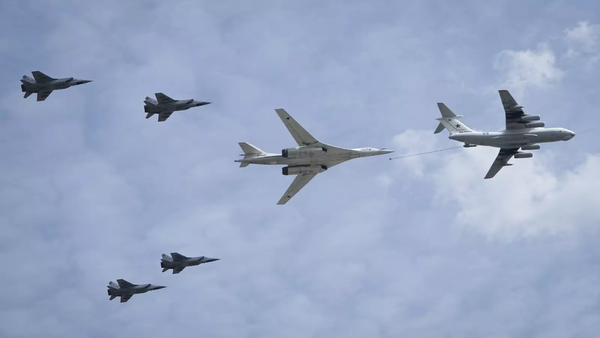
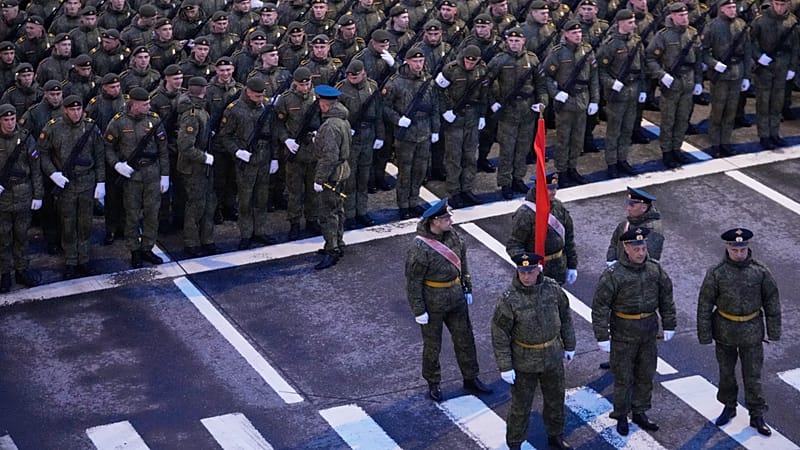
Russia's Victory Day parade returns for its 35th iteration on Saturday, 9 May. But 12 months after 11,500 troops marched through Moscow's Red Square to a cacophony of trumpets blaring, fighter jets screaming and canons blasting, this year's iteration is expected to be significantly stripped of most of its pomp – and steeped in paranoia.
Russia's defence ministry stated at the end of April no heavy military equipment will be displayed as part of the event “due to current operational situation”. Many interpret this as anxieties of Ukrainian long-range drone attacks on the capital. Days after the announcement, a Ukrainian drone hit and blasted the façade of an upmarket high-rise in the capital 7-kilometres from Red Square, marking the third day of such attacks.
Media reports also paint Russian President Vladimir Putin as increasingly fearful, with the 73-year-old leader allegedly hiding in a bunker and beefing up security due to concerns of being assassinated.
For over 25-years Putin has made the parade a centrepiece of his imperialist agenda, turning the country's most significant secular holiday commemorating the end of World War II and the defeat of Nazi Germany into an opportunity to justify certain activities.
As Russia's full-scale invasion of Ukraine grinds into its fifth year, recent parade iterations celebrating the end to the "great patriotic war" featured slogans that said: “We can do it again”. Last year, as well as many other years, Putin used his presidential address at the event to praise roughly 1,500 troops for their "bravery and determination" while fighting in Ukraine.
While the geopolitical reasons as to why Russia puts on the parade — and its attempts to draw parallels between what it posits as its sole defeat of Nazi Germany and its war in Ukraine — are clear, it is unclear what the repercussions are for those that attend – particularly those among the EU.
The EU's foreign policy chief Kaja Kallas said before the parade kicked off in 2025 that the bloc would not take these appearances "lightly". However, ostensibly, no repercussions followed. As news broke that the Slovak Prime Minister Robert Fico would attend in 2026, Euronews asked the European Commission about what consequences were meted out for previous attendances.
The Commission didn't provide any official response. However, a spokesperson said the parade is about “exploiting the end of World War II celebrations for propaganda and the justification for the full-scale invasion of Ukraine.”
“When it comes to May 9, we are celebrating Europe and all that it represents – namely peace, unity, prosperity and security,” Commission spokesperson Anitta Hipper said. “Everything that Russia is not standing for.”
Juraj Majcin, a security and defence analyst at the European Policy Centre said that without backing from all 27 EU member states, any punitive measures from the bloc for those that go are difficult to enforce. “Even if Kallas warns of consequences, there is little she – or any EU body – can do unilaterally,” he said.
In the absence of a coordinated EU response, individual countries may act on their own. “What Poland and the Baltic states have done – refusing to allow Fico’s aircraft to cross their airspace en route to Moscow – sends a strong signal,” Majcin said.
The parade is an opportunity for Russia to steal the spotlight internationally while also attracting "politicians from the EU to come and participate as well", he said.
Although Fico has said he is not going specifically to the parade, according to his public statements, he is expected to meet Putin and lay flowers at the Tomb of the Unknown Soldier: a prominent war memorial also serving state-driven narratives.
The Slovak Ministry of Foreign Affairs did not respond to Euronews' request for comment.
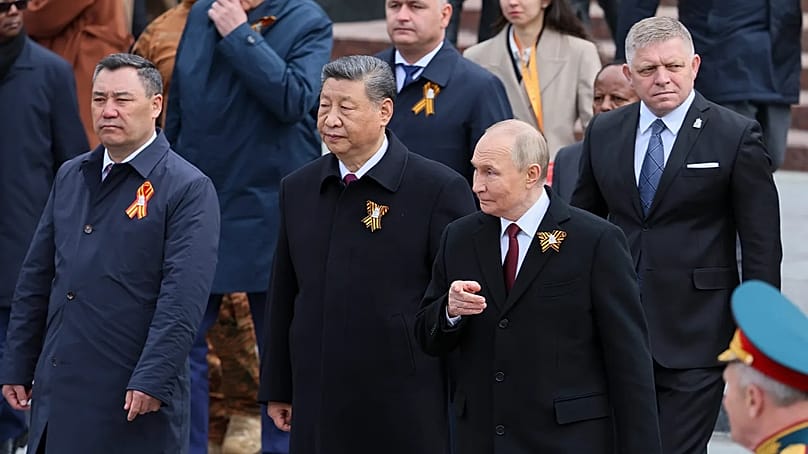
Friends of Europe senior fellow and former NATO spokesperson, Jamie Shea, said it is true that the EU has not followed through with tangible consequences for those that attend. And Fico's visit, among others, demonstrate that Putin is not isolated.
Although Fico’s visit this year falls short of full participation, Russia will still play it up and use it to its advantage. “Fico is trying to maintain a presence on both the EU and Russian fronts, albeit in a more discreet way,” Shea explained.
"This may be a discreet breaking of the marriage vows, rather than a flagrant violation of the marriage vows."
But he also points to the existential crisis facing the parade, which will proceed with no military hardware. On Tuesday, Russia temporarily shut down its airports and almost entirely restricted mobile access amid fears of sabotage or attacks by Ukrainian forces ahead of the event. In the days since, Russian machine-gun crews and snipers have been seen setting up on Kremlin towers.
For Shea, this carries significance. “The fact that Putin has chosen not to make a major spectacle of it this year – something that has been very important to the Kremlin in the past – is telling,” he said.
“Some will interpret this as a sign that Russia is so bogged down in Ukraine that it can no longer spare the troops or equipment for such displays.”
Belarus opposition leader Sviatlana Tsikhanouskaya described Moscow’s 9 May event as “a celebration of war” and “a propaganda tool in the hands of Putin.”
Belarusian President Aliaksandr Lukashenka, responsible for imprisoning Tsikhanouskaya's husband after he politically challenged Lukashenka at the polls in 2020, is a regular attendee. Russian media reports he will be present in 2026.
“Participation only helps legitimise and normalise Putin’s aggression,” Tsikhanouskaya said, adding that Lukashenko has long served Moscow’s interests “rather than those of the Belarusian people.”
Often described as Europe’s last dictator, Lukashenka faces EU sanctions over disputed elections widely recognised as rigged in his favour, as well as the violent repression and intimidation of peaceful protesters. Additionally, the landlocked country served as a staging ground for Russian soldiers to launch their full-scale invasion of Ukraine in the lead-up to 2022.
Despite the local turmoil facing Belarus, and continuous EU sanctions spearheaded against the regime, Tsikhanouskaya acknowledges the problematic optics of those that attend the military parade of Belarus' ally to the east. Rather than the event isolating Putin, it insulates him.
"At a time when Russia is waging a criminal war against Ukraine, political leaders should refuse to attend," she said.