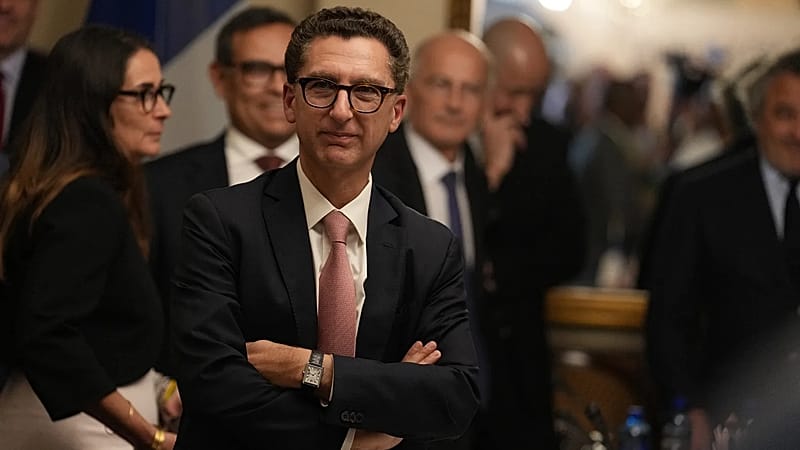
France's Human Rights League (LDH) and the CGT union announced on Saturday that they were bringing a civil case against Canal+ over allegations of discrimination relating to recent comments made by the company's CEO Maxime Saada about an open letter penned by the "Zapper Bolloré" collective.
The letter, published earlier this month in Libération, expressed concern about what it called businessman Vincent Bolloré’s “tentacular and ideological” grip over the French film industry.
Saada has since said he would no longer work with people who signed the letter, prompting CGT and LDH to decide to take legal action.
"Canal+ will appear in court for breaking the law," their statement reads.
In the text, seen by Euronews, the CGT and LDH called Saada's comments "unacceptable and brutal," accusing him of "discriminating on the basis of political and trade-union expression in order to muzzle the voices in the industry that are speaking out against Vincent Bolloré’s growing grip on the entire chain of film production and distribution."
This was not a "knee-jerk reaction" from Saada, they added, saying he was "fully aware of how essential the group is to financing film in France and of the dependence of the various players in the sector."
The civil action, led by lawyer Arié Alimi, aims to have Saada’s decision annulled, "subject to penalty payments," and to have a representative appointed to record any discrimination within the Canal+ group.
Contacted by Euronews, LDH president Nathalie Tehio said that this would be a mission of "vigilance," which could be entrusted to an employee of the group or to an external party.
"It is up to the court to decide," she added.
Action before the European Commission is also being considered to sanction what they described as an "abuse of economic dependence" by Canal+.
Breton billionaire Bolloré controls a vast media group that includes television and radio channels as well as publishing houses.
Leading industry figures including Javier Bardem and Ken Loach have signed the collective's open letter.
This text was translated with the help of artificial intelligence. Report a problem : [feedback-articles-en@euronews.com].