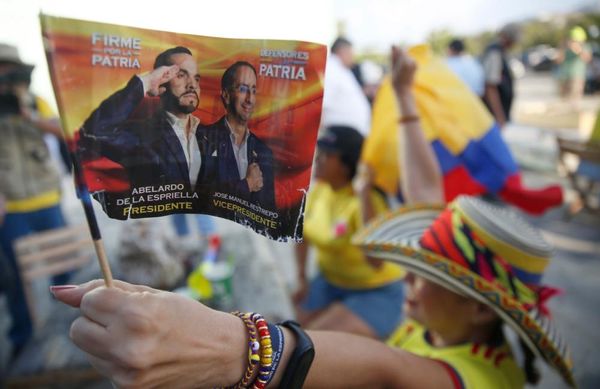
Election night in Colombia delivered the surprise few pollsters had forecast. Far-right outsider Abelardo de la Espriella led the first round of the country's presidential election with 43.73% of the vote — a commanding result that nonetheless fell short of the absolute majority needed to claim the presidency without a second round. Leftist senator Iván Cepeda, the candidate of outgoing President Gustavo Petro's Pacto Histórico, finished second with 40.93%, securing his place in the June 21 runoff. The two men will now face each other in what analysts are already calling one of the most ideologically polarized contests in Colombia's modern democratic history.
The biggest story of the night, however, was not who won — it was who collapsed. Center-right Senator Paloma Valencia, backed by former president Álvaro Uribe, received less than 7% of the vote. Liberal candidates Sergio Fajardo and Claudia López fared no better, finishing at 4% and 1% respectively. The result confirmed a massive, last-minute transfer of right-wing votes toward de la Espriella, whose campaign successfully positioned itself as the only vehicle capable of defeating the government.
More than 23 million Colombians cast a ballot — roughly 56% turnout — a figure consistent with projections. Around 400,000 voters cast blank ballots (1.7%). Electoral authorities and the Electoral Observation Mission, which deployed 1,207 international observers from 22 countries, confirmed that the day proceeded normally and safely. Despite 386 municipalities being identified as "at risk" due to armed groups, no major security incident disrupted the process.

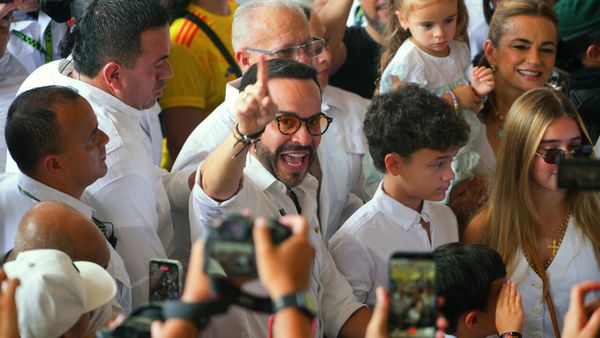
De la Espriella, a 47-year-old lawyer and political outsider, celebrated his more than 10 million votes on X, calling it a "historic achievement" and a mandate to defeat "tyranny and absolutism." His campaign has drawn repeated comparisons to Argentina's Javier Milei and expresses admiration for Donald Trump's approach to security and governance.
Cepeda now faces a steeper climb. With a deficit of roughly 650,000 votes going into the runoff, the governing coalition must now attempt to attract centrist voters and the remnants of Valencia's base to overcome de la Espriella's momentum.
The runoff sets up a confrontation between two fundamentally different visions for Colombia's future. De la Espriella has campaigned on hardline security policies, deep cuts to state intervention, and military force over negotiation — a direct repudiation of Petro's "Total Peace" strategy, which sought to bring guerrilla factions and criminal organizations to the table through dialogue. Cepeda has pledged to continue and deepen the social reforms of the Petro years.
The election is widely understood as a referendum on Gustavo Petro's four-year legacy. On June 21, Colombians will render their final verdict.