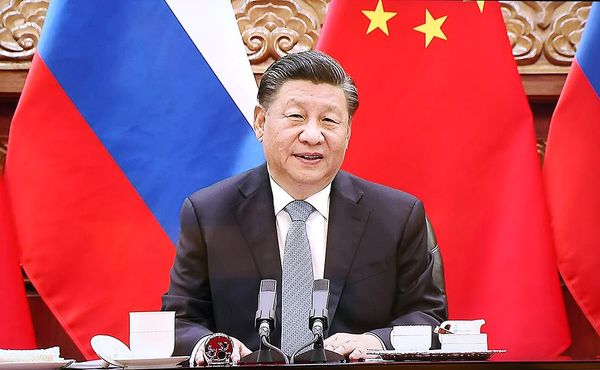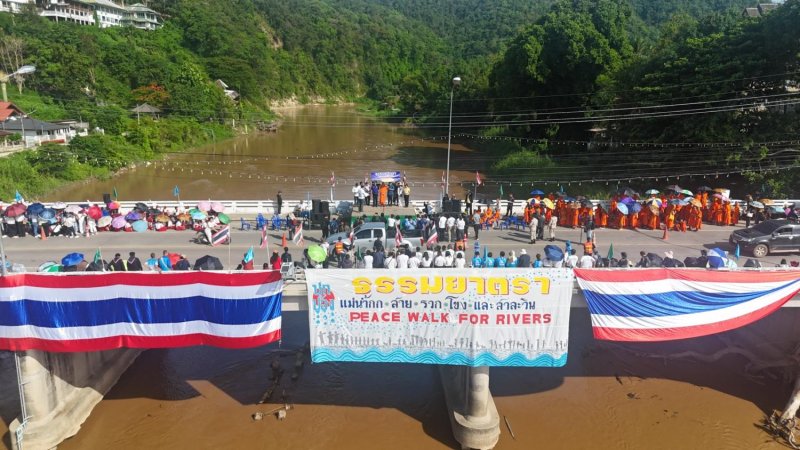
As thousands of people take part in the Peace Walk for Rivers from May 31 to June 5, marching from Tha Ton Bridge in Chiang Mai to Mae Fah Luang Bridge in Chiang Rai to defend six transboundary rivers affected by unregulated mining in Myanmar, an unexpected statement appeared on the Facebook page of the Chinese embassy in Thailand.
The statement was presented as a response to a media inquiry. The question read: "According to media reports, civil society organisations in northern Thailand will soon organise activities related to pollution in tributaries of the Mekong River. What is China's view on this issue?"
In response, the embassy said: "China attaches great importance to heavy metal pollution in Mekong tributaries located in Thailand and has taken note of monitoring results recently released by the Thai government and relevant agencies".
These findings indicate that water quality in the rivers concerned generally meets safety standards.
"China has consistently supported enhanced communication and coordination between Thailand and Myanmar, objective, science-based and responsible investigations, and the resolution of issues through friendly consultation.
"China is willing to strengthen cooperation with Mekong countries on water resources management, ecological conservation and environmental protection through the Lancang-Mekong Cooperation mechanism in order to jointly safeguard the ecological environment and water quality of the Mekong basin."
Far from calming concerns, the embassy's statement poured fuel on the fire. For more than a year, Thailand's Pollution Control Department (PCD), a state agency under the Ministry of Natural Resources and Environment, has repeatedly detected heavy metals exceeding safety standards in the Kok, Sai, Ruak and Mekong rivers.
Contaminants have entered the food chain through fish, rice fields and agricultural crops. Yet the embassy's statement appeared to gloss over this reality. Thai media and local communities have long questioned China's role in rare earth mining in Myanmar.
These operations have contaminated transboundary rivers with heavy metals and sediment. Meanwhile, calls for Chinese authorities to strengthen traceability measures and block imports linked to illegal and irresponsible mining operations -- believed to be the source of the contamination -- have received little response. It is therefore unsurprising that the embassy's statement triggered a backlash from Thai civil society groups and academics.
According to confidential assessments by Thai security agencies, surveys conducted in the headwaters of the Kok and Sai rivers in southern Shan State, near the Thai border, identified 14 gold and rare-earth mining sites in the Sai River basin and eight in the Kok River basin two years ago. Since then, the number of mining operations has expanded significantly.
These mining areas lie within territories controlled by Myanmar's military and the United Wa State Army (UWSA), which established its influence in the region with support from the military.
Thai security agencies and villagers living near the mining sites have reported that Wa and Myanmar military authorities have allowed Chinese investors to conduct mining operations with minimal environmental oversight.
Mining takes place directly in and alongside river channels, while chemicals are discharged into waterways without treatment. Rare-earth elements and gold extracted in Shan State are reportedly shipped to China for processing.
For more than a year, the Kok, Sai and Ruak rivers have been abandoned by many who once depended on them.
The Mekong, from the Golden Triangle to Sop Kok village in Chiang Rai's Chiang Saen district, has also shown alarming levels of arsenic contamination. Sediment samples collected in the Golden Triangle area contained arsenic concentrations up to nine times above hazardous thresholds, posing serious risks to aquatic ecosystems.
Research by the Stimson Center has identified 2,582 unregulated mining sites across Southeast Asia, the majority producing gold and rare earths.
Of these, 834 are located in the Mekong basin and 128 in the Salween basin, while hundreds more are rapidly expanding in Laos.
China enforces strict environmental regulations at home to protect its own citizens from the impacts of mining. Yet its rare earth investments have caused environmental damage in neighbouring countries.
Thai citizens are understandably angry at their own government's failure to protect millions of people whose livelihoods and health are increasingly at risk.
That is why they are walking. The Peace Walk seeks to push the Thai government to act more decisively. China, a major player in the rare earth supply chain, cannot avoid confronting the problem. The Mekong region is rapidly becoming one of the world's emerging contamination hotspots. It is a stark reflection of weak governance, corruption and the failure to regulate mining in frontier areas.
On June 5, World Environment Day and the final day of the Peace Walk, participants will submit a letter inviting Prime Minister Anutin Charnvirakul and the Chinese ambassador to Thailand to attend a public forum in Chiang Rai and hear directly from those affected by the crisis. The question is whether they are willing to listen.
Paskorn Jumlongrach is the founding editor of a non-profit independent news outlet based in Thailand, www.transbordernews.in.th.