Any great midfield tandem requires each member to be acutely aware of what is happening with the other. It’s little surprise, then, that Stephen Eustáquio would be the first to alert the rest of Canada to Ismaël Koné’s injury.
“I saw his leg,” Eustaquio told reporters after Thursday’s 6-0 win over nine-man Qatar. “I saw that something wasn’t right, and I just wanted for the medical staff to get in as quick as possible.”
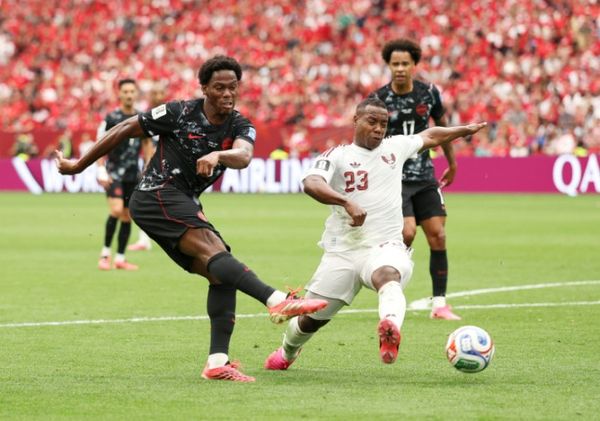
The broadcast caught Koné’s initial glance at his lower left leg, visibly mangled after a kick from behind by Qatar midfielder Assim Madibo.
Canada were 3-0 ahead at that point after a bombastic first half, but the nature of the challenge in the 51st minute – and the reaction of both teams – cast a pall over proceedings. As medics ran on to the field Koné’s teammates rushed to his defense, taking umbrage with the nature of Madibo’s challenge.
After the match, Qatar forward Yusuf Abdurisag declined to comment further on the sequences, instead commending his teammates for their heart and effort after the game’s first red card was shown to Homam Ahmed in the first half.
“They tried to defend their players, and we tried to defend ours,” Eustáquio said. “I think it’s normal, they still want to go far in this competition, but at the same time it’s a clear red. Like, there’s no debate in that he basically broke his leg. They want[ed] a yellow, but for me it makes no sense.”
The fracas resumed after the whistle after a confrontation between coaches Jesse Marsch and Julen Lopetegui.
By the final whistle, Canada had not just secured their first men’s World Cup win but striker Jonathan David had become the first player on a host nation’s team to score a World Cup hat-trick since Geoff Hurst (1966).
Considering Koné’s importance to Canada, however, David wasn’t able to relish in the deserved spotlight.
“He means everything to this team,” David said. “If you [ask] the same question to any guy on the team, they will tell you the same. I don’t even know how to describe him. He’s someone that we love a lot.”
Alistair Johnston compared the moment to a similar injury at training during the 2024 Copa América. As the Celtic defender remembers, he played a pass to right-flank partner Tajon Buchanan before hearing what “sounded like a gunshot” in what ultimately was a broken tibia for Buchanan.
While Johnston was on the opposite side of the pitch from Koné’s point of contact on Thursday, the moment hit him with similar impact.
“He’s a kid that’s so easy-going, and just loves the sport so much,” Johnston said. “We talked about it before, but he could stay up all night just playing two-touches with the guys, and that’s why I think it hurt so much. It’s just his love of the game. To see someone like that go down in such a needless challenge as well? It’s frustrating.”
In the five minutes after Koné’s injury, Canada goalkeeper Maxime Crépeau was consoling defender Luc de Fougerolles. Crépeau is no stranger to such horrific injury. In goal for Los Angeles FC in the 2022 MLS Cup, he committed to a sliding sweeping action beyond his attacking third and collided with a Philadelphia Union opponent. The sequence left him with a fractured right leg and ruled him out for the 2022 World Cup.
A calming presence for a team on the rise, Crépeau knows all too well what lies ahead for Koné once he begins his rehabilitation process. He’s also the embodiment of a positive ending; Crépeau made his World Cup debut against Bosnia and Herzegovina last week. And now he’ll be among the leaders working to ensure Canada can build off of the positives from Thursday’s win and continue to play to make their injured midfielder proud.
“Every guy lives the emotions a certain way, and we went through the emotions in that time,” Crépeau said of his moment with De Fougerolles. “Man, it’s so difficult to put into words, but it’s just a moment to say, ‘Hey, you’re not alone. I’m feeling the same thing as you, but we have a job to finish for him.’”