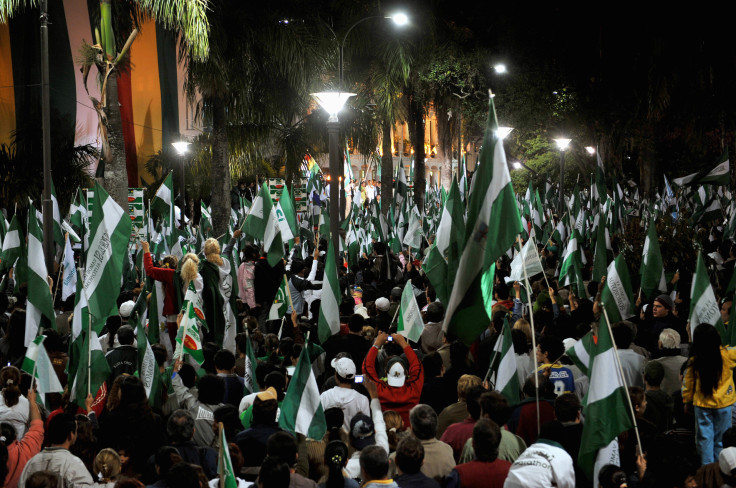
(UPDATED — 9:39 p.m. EST) Tens of thousands of citizens gathered in Santa Cruz for the massive civic mobilization "Gran Marcha por la Democracia". Led by the Comité Pro Santa Cruz, civic leader Stello Cochaminidos issued a formal ultimatum to President Paz: restore order and clear the ongoing blockades by this Sunday, or citizens will take matters into their own hands. The Asamblea de la Cruceñidad has declared a permanent state of emergency as the weekend deadline looms.
This is the second in a series of reports on Bolivia's ongoing political and economic crisis. Read Part One here.
SANTA CRUZ DE LA SIERRA, Bolivia — Three weeks into Bolivia's political crisis, a different story is emerging from the one dominating international headlines — one that doesn't fit neatly into the narrative of a nation united against its government. While certain sectors have taken to the streets with genuine grievances, the suggestion that their movement represents the majority of Bolivians is, at best, a stretch, and at worst, a distortion that serves the interests of those engineering the unrest. Across the country, Bolivia is not just resisting the blockades. It is actively fighting back.
The Map of Disruption: Where the Blockades Actually Stand
After three weeks of conflict, Bolivia's Road Administration (ABC) reported at least 45 active blockade points across various regions of the country. The heaviest concentration was in the department of La Paz, which alone accounted for 17 of those points, making it by far the most affected region. Additional blockades were active in Chuquisaca, Oruro, Potosí, Cochabamba, and Santa Cruz.
That picture is serious — and should be treated as such. Seventeen blockades choking the roads in and out of La Paz alone is a humanitarian emergency, not a minor inconvenience. Bolivia's Ministry of Health reported the death of a child in Potosí as a direct result of the blockades, and La Paz's children's hospital declared an emergency over shortages of oxygen, medications, and food.
But the situation is neither total nor without relief. Humanitarian corridors have been negotiated with the involvement of the Red Cross and the Catholic Church. Chile's Air Force sent a Hercules transport aircraft carrying five tons of food. Argentina dispatched its own humanitarian flight. Overnight on Wednesday, 70 tanker trucks carrying gasoline were allowed through from a state oil company plant in El Alto. The supply chain is strained and in places broken — but it has not collapsed entirely, and international solidarity has begun to fill some of the gaps.
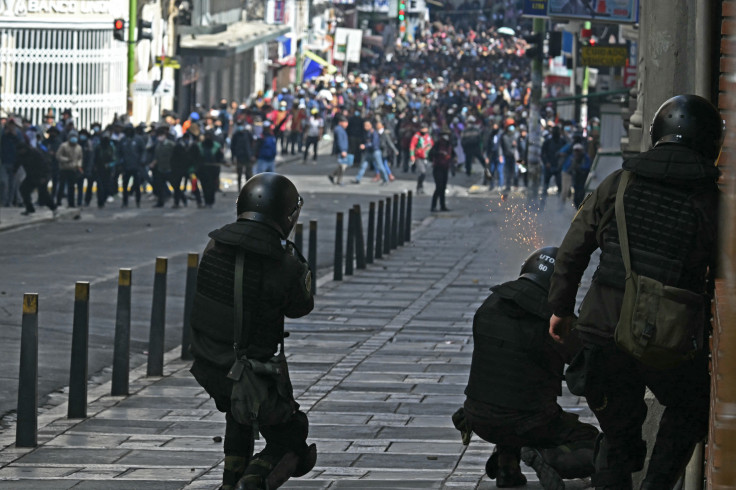
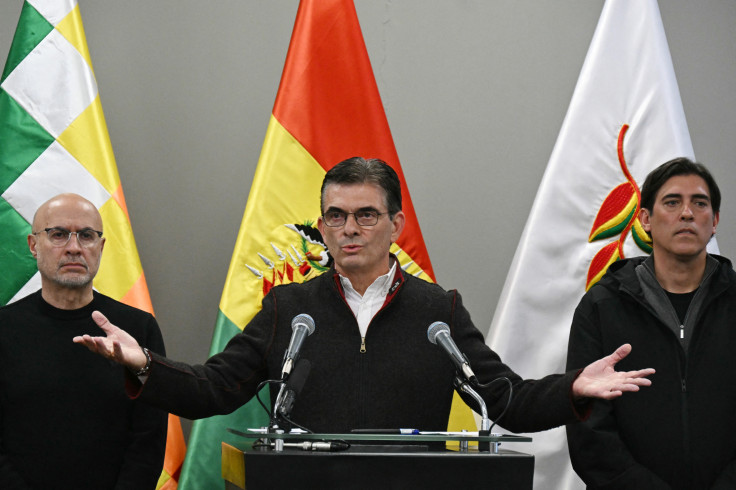
Critically, the blockades are not uniformly distributed across Bolivia. Routes from Santa Cruz to the Brazilian and Paraguayan borders have continued operating normally throughout the crisis. Meanwhile, security forces have been actively working to clear strategic corridors. In Cochabamba, police launched an early-morning operation deploying a large contingent of officers and military personnel advancing from Sipe Sipe toward Parotani to restore transit on the interdepartmental highway connecting Cochabamba with the country's west — a critical artery. Protesters responded by hurling rocks from the hillsides to prevent the road from being cleared. President Rodrigo Paz has made a public address warning all vandals and unlawful dissidents with arrest.
Santa Cruz Stands: The Democratic Counterweight
Nowhere is the complexity of Bolivia's moment more visible than in Santa Cruz de la Sierra — the country's most populous city and by far its most powerful economic engine, responsible for roughly 30% of Bolivia's GDP and the agricultural and agro-industrial output that feeds much of the country.
Compared to La Paz, Santa Cruz's highways tell a different story. And its civic and political leadership has made it unmistakably clear they intend to keep it that way: anyone who attempts to bring blockades to the department has been warned they will face forcible removal. It is a warning with teeth — Santa Cruz has a long history of civic mobilization, and its institutions have both the organization and the will to back it up.
More than that, Santa Cruz went on offense. The "Asamblea de la Cruceñidad", the governing authority of the civic assembly — Comité Pro Santa Cruz —, convened in response to the escalating conflict determined that a peaceful march called the "Gran Marcha por la Democracia" would take place on Thursday, May 21, departing from the Plaza del Estudiante and concluding at the Plaza 24 de Septiembre. The march is open to institutions, authorities, students, and citizens at large, and was backed by the departmental governor Juan Pablo Velasco, the mayor of the city of Santa Cruz, Manuel Saavedra, and the president of the Departmental Legislative Assembly, María René Álvarez.
Thousands of citizens poured into the Plaza 24 de Septiembre — the city's central square and its traditional gathering point for moments of democratic significance — for a march in defense of democracy. The scenes were a striking counterpoint to the images from La Paz: not miners with dynamite, but ordinary citizens, families, business owners, and civic leaders, united in their rejection of what they see as an antidemocratic attempt to topple a government through street pressure rather than the ballot box.

The mood in Santa Cruz is one of perceptible, organized unity. Several civil society speakers and politicians have been vocal and very critical of president Rodrigo Paz's government's handling of the crisis and its perceived inability to protect governability and enforce the constitution more forcefully. Their frustration is real and are set to hold an address and make a public statement. Their motive is equally clear: the answer to a bad government is elections, not chaos. As El Día, Santa Cruz's independent newspaper, put it in a pointed editorial, Santa Cruz functions precisely because the state is absent from its economic life in the way it dominates Bolivia's west. "To Santa Cruz you don't come to ask; you come to contribute," the paper observed. Every crisis that paralyzes the Andean west, it argued, ultimately reinforces Santa Cruz's case for decentralization — and for a Bolivia where economic life is not held hostage to whoever controls the streets of La Paz
The contrast is stark and deliberate. La Paz, the editorial argues, "suffers two chronic ills that feed each other and deepen mutually: state-ism and centralism. La Paz concentrates everything: power, budget, institutions, patronage. Toward it march the unions to demand, the unionists to negotiate, the political mafias to divide the spoils." Santa Cruz, by contrast, has built its prosperity on a fundamentally different model — one the editorial argues is now facing its most important test.
Counter-Protests: The Bolivians the World Headlines Missed
The marches in La Paz have drawn global attention. The counter-marches have drawn far less — but they are happening, and they matter enormously for understanding the true state of Bolivian public opinion.
In La Paz itself, counter-protesters have taken to the streets to condemn what they describe as antidemocratic movements that have engulfed the country. Hundreds of citizens organized through citizen platforms known as "pititas" marched through La Paz's historic center on two consecutive nights, with Bolivian flags and chants against the blockades, demanding the restoration of order. Thousands gathered to express support for institutional order and to push back against the narrative that the blockades represent the will of the Bolivian people
The civic mobilization quickly spread beyond Santa Cruz: committees in Cochabamba and Tarija confirmed their adhesion to the pro-democracy marches, with Tarija taking to the streets a day earlier. The national call emerged from the Asamblea de la Cruceñidad on May 18, which brought together departmental and municipal authorities, civic leaders, social sector representatives, and regional figures around the common cause of defending democracy, legality, and the country's economic stability. One civic leader in Tarija put it plainly: "The democratic system is threatened by an irrational mobilization sustained by money of obscure origin coming from the Chapare. We invite all the population to join us, in defense of the democratic system and freedom."
In Cochabamba, unions of merchants, transport workers, local producers, and neighborhood councils marched under the banner "Cochabamba for Peace, Work, and Democracy," convened by the regional Multisectoral Committee. Hundreds took to the streets carrying white flags and Bolivian flags, with the chant: "Enough blockades, we want to work."
These are not fringe voices. They are a significant cross-section of Bolivian civil society — urban professionals, business owners, students, civic leaders — who are appalled by what they see happening to their country and determined to say so publicly. It is worth noting that by May 20, three people had died and 90 had been arrested in connection with the protests — tragic figures, but also ones that speak to a protest movement that, while disruptive and in places violent, has not achieved the kind of total national participation its organizers have claimed. The protests were led initially by the Bolivian Workers' Central, or COB, alongside peasant unions and miners — organized labor and sectoral groups, not a spontaneous popular uprising. The distinction matters.
The Municipal Council of Santa Cruz Speaks
The pushback is not only in the streets. It has reached Bolivia's formal institutions. On Thursday, the Municipal Council of Santa Cruz de la Sierra issued an official declaration, read by Council President Luisa Nayar: "As the Municipal Council of Santa Cruz de la Sierra, we firmly reject the blockades, the violence, and any attempt at a coup against the democratically and legally constituted government, and we declare ourselves in a state of emergency in the face of the escalating conflict that threatens social peace and national stability."
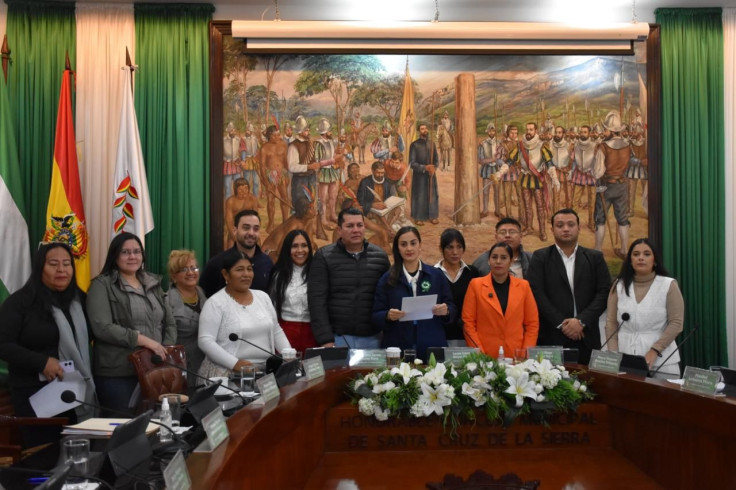
The declaration was unsparing in its historical memory. The Council lamented that Bolivia was once again suffering a severe food, social, and humanitarian crisis "caused by radical and intolerant groups that answer to Evo Morales and other political and union actors." It also rejected the country being "held hostage" to chaos and confrontation, noting: "This is not the first time they have tried to break democratic order. They already did it in 2003 and 2005 to reach power; later they promoted confrontation between regions and persecuted those who defended democracy, autonomy, and freedom. In 2019 they carried out a monumental fraud. For years they governed squandering state resources and using fear, persecution, and the abuse of power against those who thought differently."
The Council made clear that Bolivians want to live in peace and work, and that they would not allow radical interests to continue destroying the country or pitting compatriots against one another: "Social peace and democracy are non-negotiable."
Bolivia Is Polarized — Not Uniform
Bolivia on Thursday was mobilizing on two simultaneous and opposite fronts: in La Paz, the Bolivian Workers' Central (COB), Morales-aligned sectors, and social organizations confirmed new marches and protests against the government, with the call for Paz's resignation as their central demand. Simultaneously, in Santa Cruz, Cochabamba, Chuquisaca, Beni, and other regions, civic committees, citizen platforms, business associations, and productive sectors mobilized in defense of democracy and in rejection of the blockades.
This polarization — genuine, deep, and running along clear geographic and socioeconomic lines — is the reality that international coverage has largely flattened. To describe Bolivia's crisis as a monolithic popular uprising is to hand Morales and his allies a narrative they have not earned. The country is divided. One half is fighting to remove a president through street pressure. The other half is fighting to keep him — and to keep Bolivia's democratic institutions intact.