US inflation is still sitting at about 3.8%, while economic growth has clearly slowed. Weak consumer confidence, sticky prices, and low growth are starting to look like a stagflation-style setup. On top of that, rising tensions from the Iran–US conflict are adding extra pressure and making investors even more cautious.
Global liquidity is also uneven. While central banks paused aggressive tightening, balance sheets are no longer expanding as fast as before. Broad money supply (M2) growth in major economies is near-flat to low single digits, compared with double-digit expansion during the pandemic years.
In this environment, investors are rotating into “hard assets” again. Two assets leading that conversation right now are Bitcoin and Gold.
Gold is having one of its strongest years in decades. After briefly moving above $5,500 earlier in 2026, prices are now trading near $4,440 per ounce. However, the Bitcoin price was moving through a different phase. Following its major rally in 2025, the market has slowed down, with BTC now trading near $77,000. This is still under the record highs reached toward the end of 2025.
So, the question is: in a stagflation-driven economy like this, which of these two actually holds up better as a store of value?
Gold and Bitcoin Took Different Paths
Back in 2024, Bitcoin was the number-one asset in the markets. The approval of spot Bitcoin ETFs and rising institutional demand pushed prices sharply higher. Bitcoin gained more than 135% during the year.
Even though Gold also had a good year with a 35% climb, the asset couldn’t compete with Bitcoin’s explosive momentum.
Yet things took an unexpected turn in 2025 and early 2026.
Investors started to become concerned about inflation and slow economic growth. Their focus shifted from aggressive growth to stability while central banks increased reserves. So, Gold took the lead as a safer asset option.
The faded risk appetite brought a consolidation phase for Bitcoin with price swings. Weakened technology stocks also added to the woe. Despite all this, the asset remained strong overall, but it was not enough to match the momentum it had shown in the previous cycle or to break out of its consolidation range.
Basically, the two assets behaved differently in the economic condition.
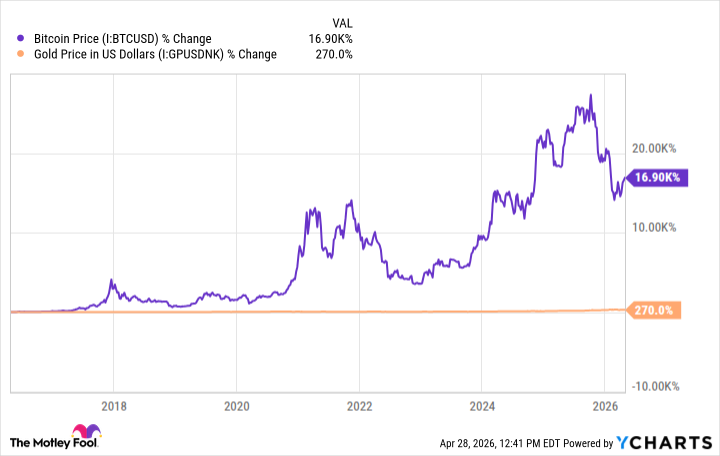
Gold continued with its usual steady strength, even during the rising inflation and global instability. Meanwhile, Bitcoin behaves more like a high-growth liquidity asset, performing best only in high-risk appetite and loose financial conditions.
Crypto Investors Are Also Buying Gold
The changing economic conditions in 2026 birthed a new trend: crypto traders are turning toward Gold. This led even some of the leading crypto platforms to introduce new tokenized Gold products and Gold futures trading, thus allowing traders to gain Gold exposure directly through blockchain platforms. Reports suggest tokenized Gold trading volumes crossed billions of dollars during the first half of the year.
This shows something important: blockchain technology is not replacing Gold. Instead, it is helping make Gold easier to access globally.
Many investors now see both assets as complementary rather than rivals.
Gold Still Dominates in Size
Even with Bitcoin’s rise, Gold is still on a much bigger scale. Many countries(the United States, China, and India, etc.) keep adding to their Gold reserves, aiming for long-term financial stability. The estimated total market value of Gold is at around $22 trillion to $26 trillion, and it’s deeply tied to global reserve systems.
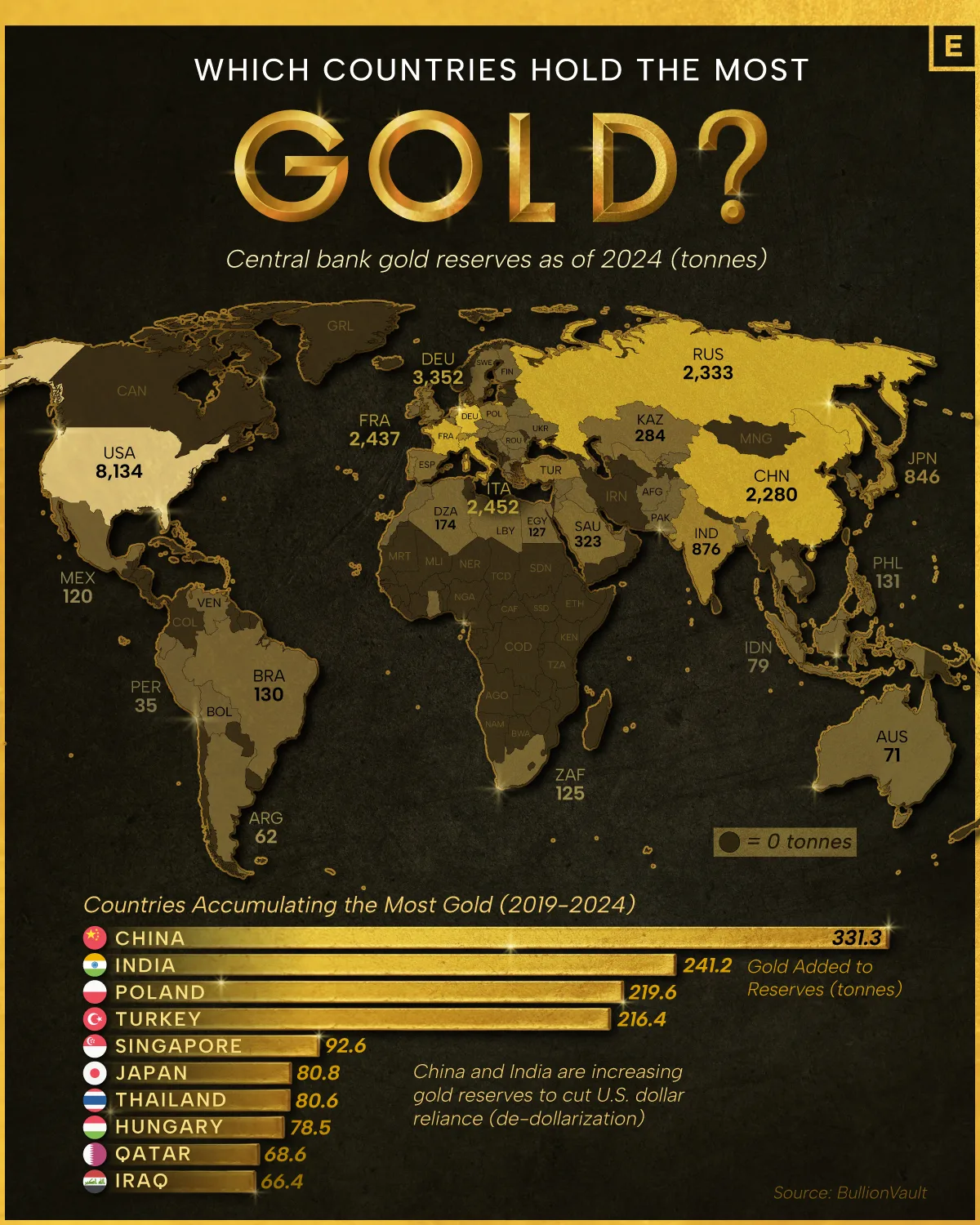
Central Bank Gold Reserves By Country |Source
Bitcoin’s market capitalization is closer to $1.5 trillion. That is still massive compared to previous crypto cycles, but it remains much smaller than Gold.
Still, Bitcoin has matured significantly.
Spot Bitcoin ETFs now hold tens of billions of dollars in inflows. These institutional investment products created stronger long-term support for the asset and reduced fears of a total market collapse like in earlier crypto cycles.
Bitcoin is no longer operating outside mainstream finance.
Gold vs. Bitcoin: Strengths and Weaknesses
Why Gold Still Matters?
Gold has a reputation to be a reliable asset throughout history, holding its value across times of inflation, wars, and financial crises. More importantly, it also doesn’t rely on any technology, so there’s no exposure to software issues or cyber risks.
That reliability explains why central banks continue buying large amounts of it.
However, the biggest weakness of Gold remains its mobility. Moving large amounts of physical bullion is expensive and challenging, especially across borders.
Why Bitcoin Attracts Investors?
Bitcoin is a digital asset and has zero portability challenges. It also has a fixed supply, which is something Gold does not offer.
There will only ever be 21,000,000 BTC. That hard cap is one of the biggest reasons people compare Bitcoin to Gold. No government can print more of it. No central bank can expand its supply.
However, the asset is highly volatile and linked to liquidity conditions, investor mood, and tech-market sentiment. This makes it less stable in the short term than Gold.
Gold vs Bitcoin Comparison
|
Metric |
Gold |
Bitcoin |
|
Current Price (May 2026) |
~$4,440/oz |
~$77,000 |
|
2026 Trend |
Bullish |
Consolidating |
|
Main Driver |
Central Bank Demand |
ETF & Liquidity Flows |
|
Volatility |
Low to Moderate |
High |
|
Infrastructure Dependency |
None |
Internet & Exchanges |
What Analysts Expect Next?
Large financial institutions remain bullish on Gold.
Banks like UBS recently lifted medium-term Gold targets toward $5,200 per ounce, while some longer-term forecasts approach $5,900.
Bitcoin analysts also remain optimistic. Many traders believe Bitcoin is building a strong support base near current levels. If the asset can reclaim the important $81,500 resistance zone, analysts believe another rally toward $100,000 could happen later in 2026.
Still, professional investors are no longer thinking in terms of “Bitcoin versus Gold”.
Instead, many portfolio managers now recommend holding both assets together.
A common strategy includes larger exposure to Gold for stability and smaller exposure to Bitcoin for higher-risk growth potential.
Final Thoughts
Investors are turning toward hard assets again in 2026. In a time of stagflation like this, Gold continues to perform, being a reliable store of value.
On the other hand, Bitcoin is also evolving into a mainstream asset, gaining broader global acceptance year after year.
The asset has survived multiple corrections and continues attracting institutional money through ETFs and long-term holdings. That level of support would have been difficult to imagine a few years ago.
The real debate today is no longer about choosing one asset over the other.
That is why many investors no longer see this as a competition and prefer to have both assets in their portfolio.
Is Bitcoin outperforming Gold as a store of value in 2026?
In the current stagflation phase, Gold is performing better in the short term. However, over the long run, Bitcoin has still beaten Gold by a wide margin across five years.
Why are central banks buying Gold instead of Bitcoin?
Central banks stick with Gold because it doesn’t rely on digital systems or third-party platforms and has been a trusted asset for thousands of years.
Can Bitcoin and Gold rise together?
Yes, especially when fiat currencies weaken.