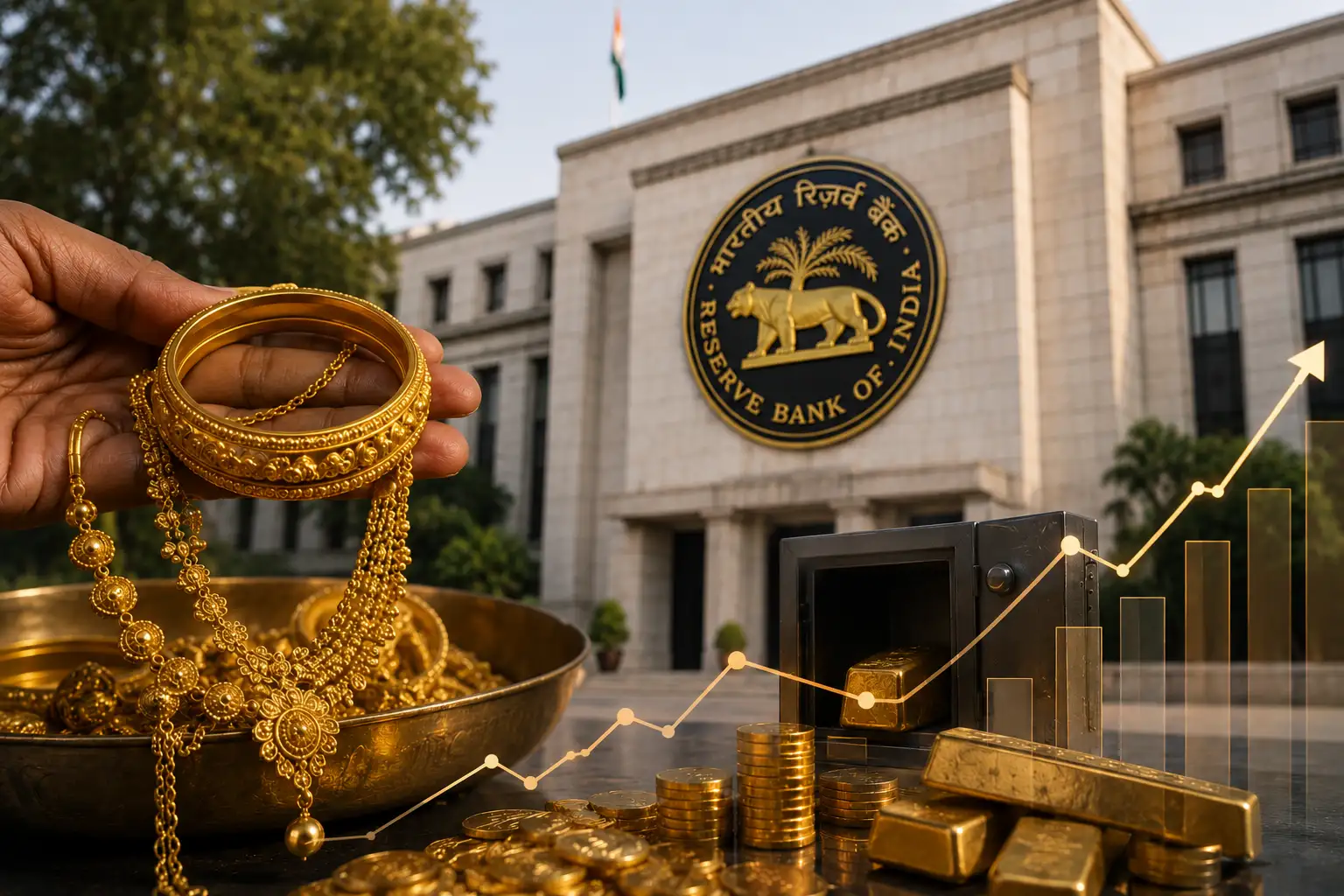
Amid Prime Minister Narendra Modi’s appeal to curb gold purchases due to the ongoing West Asia conflict, industry bodies from the gems and jewellery sector are preparing to urge the government to revive and strengthen the Gold Monetisation Scheme.
Domestic gold mobilisation and recycling could be a better solution to foreign exchange problems rather than deferring purchases, which could threaten the livelihoods of 35 million people, jewellery industry body 'All India Jewellers and Goldsmith Federation' said on Monday. The body has called for an overhaul of the country's gold mobilisation framework instead of deferring purchases of the precious metal as suggested by Prime Minister Narendra Modi.
What was the scheme?
The Gold Monetisation Scheme was announced on September 15, 2015, with the objective to reduce country's reliance on the import of gold in the long run and mobilise gold held by households and institutions in the country to facilitate its use for productive purposes. The GMS is comprised of 3 components -- Short Term Bank Deposit (1-3 years); Medium Term Government Deposit (5-7 years), and Long-Term Government Deposit (12-15 years).
Of the total 31,164 kgs of gold till November 2024, Short term Gold Deposit accounted for 7,509 kg, Medium Term Gold Deposit (9,728 kg), and Long Term Gold Deposit (13,926 kg). There were about 5,693 depositors who participated in GMS.
What happened to the scheme?
In 2025, the government discontinued the scheme in view of the evolving market conditions.
Till November 2024, approximately 31,164 kilograms of gold have been mobilised under GMS.
What are new proposals?
Even before Prime Minister Narendra Modi’s recent appeal to limit gold purchases, the All India Gem and Jewellery Domestic Council had, in April, announced that it was in talks with the Reserve Bank of India and the Ministry of Finance to push for a major overhaul of the Gold Monetisation Scheme (GMS), according to ET.
The proposed revamp aims to fix structural bottlenecks and improve the scheme’s adoption and effectiveness while remaining within the existing regulatory framework laid down by the RBI and the Government of India. The new model seeks to retain the current architecture of the scheme but introduce greater operational efficiency and stronger coordination among stakeholders.
A key highlight of the proposal is the shift towards a digital gold ecosystem, where physical gold can be converted into dematerialised gold balances held within the banking system through structured accounts.
The industry body noted that demand for gold bullion and coins has risen steadily in recent years, with investors increasingly viewing physical gold as a reliable store of value. The revamped GMS aims to tap into this trend by allowing investors to monetise idle gold holdings such as jewellery, bullion and coins without having to sell them.
Under the proposed framework, these non-yielding assets could be converted into interest-bearing financial instruments integrated with the formal financial system. Industry experts believe greater mobilisation of idle gold could help reduce India’s dependence on imports, support domestic supply and ease pressure on the Current Account Deficit (CAD). The move towards a regulated digital gold framework is also expected to improve compliance, boost formalisation and enhance overall market efficiency.
Rajesh Rokde, Chairman GJC, said, “The proposed model integrates jewellers into a regulated, digital ecosystem, significantly enhancing transparency, trust, and accessibility for consumers. By unlocking the value of idle gold, the scheme has the potential to strengthen domestic supply, reduce reliance on imports, and contribute meaningfully to India’s macroeconomic stability." Avinash Gupta, Vice Chairman GJC, said “The revamped GMS framework is designed to be practical, scalable, and fully aligned with regulatory expectations. It creates a secure and transparent pathway for gold monetisation, while ensuring accountability across all stakeholders. Importantly, it enables investors to earn returns on idle gold—including bullion, coins, and jewellery—thereby transforming a traditionally non-yielding asset into a productive financial instrument. This will play a critical role in formalising the sector and improving overall market efficiency."