Over the next month, Liam Bolitho and Rachel Rouse will remove decking, disconnect their electricity and air conditioners and clear the space underneath their North Lismore home.
In July, contractors will chainsaw the couple’s home of 10 years in half and load it into trucks. Then they will take the house – among more than 4,000 assessed as uninhabitable after 2022’s devastating floods – to a plot of land above the flood level.
The couple have done it all without the help of the New South Wales government’s $100m Resilient Lands Program (RLP), established in October 2022 to provide land for flood-affected residents to relocate or build new homes. Instead the couple found and bought the land themselves for about $500,000.
“When they first announced these programs, we were like, that sounds great, that’s what we want,” Bolitho says. “We were always asking the Reconstruction Authority, ‘Hey, when’s the land coming up?’
“After the initial six months, we were like, ‘Man, these guys don’t know what they’re doing’.”
The $100m RLP and the $880m Resilient Homes Program (RHP) – a scheme to buy back homes and fund retrofits, house raises and relocations – were rolled out after the floods as part of the costliest disaster recovery program in Australian history. But a damning report released last week by the NSW auditor general found that, after three-and-a-half years, the RLP is yet to deliver a single home or lot. The report found neither program was planned effectively before their rollout, causing delays and a “significant impact on their ongoing implementation”.
The auditor general has recommended the NSW Reconstruction Authority (NSWRA) – which oversees both programs – takes action by September to accelerate the delivery of the RLP sites. The NSWRA’s chief executive, Kate Fitzgerald, has said she accepts the findings and will act on the recommendations.
But for many – including Bolitho and Rouse – those efforts will come too late.
Commitment confusion
The extensive flooding in the northern rivers between late February and early April 2022 led to the deaths of 13 people. More than 4,000 properties were left uninhabitable and another 10,849 were damaged.
When the RLP was announced, landholders were urged to propose suitable land. But the program’s strategy, which identified 12 sites to deliver housing in the region, was not published until August 2024.
Last week’s report found it had yet to deliver any of this land. Nine of the 12 sites are now due to be completed by the end of this year or during 2027, with the remainder planned to be completed in 2028.
Residents will be offered the chance to buy lots in the first of the sites, in North Lismore, in the middle of this year, with home relocations beginning in early 2027.
Saffron Bond, whose mother is waiting for the chance to buy one of the lots, is sceptical.
“They’re saying June but we all know, when they tell us a date, you add six months,” says Bond, who is occasionally interrupted by her loudly crowing rooster.
Bond, like Bolitho and Rouse, has used the money from a “buyback” she received from the RHP to privately find and purchase her own lot. She was part of a group from Lismore who relocated their homes to an estate of vacant lots they found in Nimbin to the north.
“We gave [the NSWRA] more support than they gave us, because they watched what we did and went, ‘We can create a template from this’.”
Sign up for the Breaking News Australia emailResidents were initially told there would be $1.5bn in funding for 6,000 homes to be remediated or bought back. Of those, 4,000 would undergo “resilient measures” including retrofits, locations and raises through the RHP.
The NSW government has denied this was ever a firm commitment, although the $1.5bn figure was part of the proposal to federal cabinet by the NSWRA’s predecessor, the Northern Rivers Reconstruction Corporation.
The Lismore MP and NSW recovery minister since March 2025, Janelle Saffin, has said she advocated for a commitment as a local member but, when the program was announced, “the government made it clear it was 2,000 houses all up” and buybacks were the priority.
The auditor general’s report found that, as of the end of March this year, 793 buybacks have been carried out through the RHP, while only 54 resilient measures had taken place, with about $581.5m of the total funding allocated. Applications have now closed.
Saffin told Guardian Australia both the RLP and RHP were “established in the immediate aftermath of the unprecedented 2022 floods under the previous government”.
“We understand that responding at speed to this disaster meant that vital upfront planning and governance systems were not where they should have been.
“A lot has been achieved under the program, including moving hundreds of people off high-risk floodplains and we remain committed to accelerating the delivery of safe land.”
She said the government accepts all the auditor general’s findings and “work is already under way”.
‘A homesickness while you’re still at home’
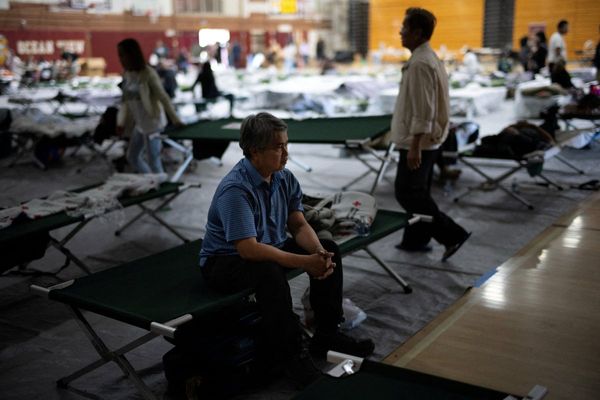
All the residents Guardian Australia has spoken to say the same thing – that the period since the floods has been more traumatic than the flood itself. Although residents say they are exhausted by years of advocacy, anger with the state government remains raw.
While the Minns government has sought to blame the previous Coalition government for setbacks with the RHP and RLP, its own approach has drawn criticism, including the high-profile demolitions of buybacks the NSWRA has deemed uninhabitable and the demonisation of squatters.
For Yani Clarke, who made an expression of interest in the RLP with her partner, the findings are not a surprise. She has just relocated their 120-year-old timber home – gifted to them by an older couple who could not face relocation – from South Lismore to a less flood-prone area in Modanville.
After years of waiting, Clarke and her partner found and bought a plot of land themselves using what she calls “creative solutions”: working extra hours, loans and help from family.
While they wait for an occupation certificate confirming their relocated home is safe to live in, they’re living in another place in South Lismore, watching their old neighbourhood disappear as homes are fenced off and demolished.
She describes the feeling as “solastalgia”, distress caused by environmental change to your home. “It’s like a homesickness while you’re still at home.”
Rouse was pregnant with her and Bolitho’s second child when the flood hit in 2022. Bolitho, who is not a carpenter, stripped, dried out and relined the house in time for his second daughter to be born at home six months later. “[The home] was almost better than before the flood,” he says.
Their children have only known Lismore during the recovery. Bolitho says he and Rouse don’t shy from talking “deeply” with them about what’s happening, as homes in their old neighbourhood disappear around them.
“The story that we wanted to show, especially our elder daughter, who’s just about to turn six, is that sometimes life can throw you mud … and you just have to get through it, and sometimes you have to do it without the help of others.”