This is the third part of an investigative series examining pharmaceutical companies linked to the deaths of children from contaminated medicines, and the regulatory failures that allowed them to keep operating. It is supported by the Thakur Foundation. The foundation has not exercised any editorial control over the project.
In a photograph on the Facebook page of his family foundation, Sachin Jain looks every part the concerned philanthropist — light green shirt, neat spectacles, a smile on his face, talking to children about personal hygiene. It is a carefully composed image of a man of social purpose, working for underprivileged children.
Scratch the surface and a different picture emerges. Jain owns Marion Biotech Private Limited, a pharmaceutical company whose cough syrups a Tashkent court found responsible for the deaths of 68 children in Uzbekistan between 2022 and 2023. Sixteen more were left with disabilities.
But Jain has never been convicted. He hasn’t even spent a single night in custody in either Uzbekistan or India. In fact, with more than 20 companies spanning pharmaceuticals and real estate under his and his family members’ directorship, Jain’s corporate machinery has continued to operate largely undisturbed.
In this story, we trace the Uzbekistan court’s findings, what Indian officials found, and how Marion Biotech owners have so far not been convicted in either country.
The colds that turned fatal
In early July 2022, in a modest home in Kungrad, in remote Karakalpakstan – an autonomous republic within landlocked Uzbekistan – a two-year-old boy developed a seasonal cold. There was no reason for alarm.
His parents, Tomatov Azamat Aitbaevich and Bakhtiyarova Dilnoza Rashid Qizi, took Aitbaev Akhmad Azamatov to the Kungrad City Medical Association. The doctor prescribed anti-inflammatory medicines. When some of these were unavailable at the Ajiniyaz pharmacy inside the Kungrad Farmers’ Market, the pharmacist suggested an alternative: Dok-1 Max syrup.
Within two days, Akhmad’s condition worsened. On July 6, 2022, his parents rushed him to hospital, where he was admitted to the infectious diseases ward. The child stopped urinating. Doctors diagnosed acute kidney failure. Two days later, he was transferred to the Emergency Medical Hospital in Nukus and placed in intensive care. But on July 25, he slipped into a coma. He died six days later.
Akhmad’s parents did not know then that their son would become the first recorded death in Uzbekistan linked to Dok-1 Max syrup, manufactured by Marion Biotech.
In the months that followed, more children across Uzbekistan fell ill in the same pattern.
On September 29, 2022, two more children died — Norsoatov Muhammadjon Mukhriddin Ugli from the Kashkadarya region and Kuchimov Imronbek Mirusmon Ugli from the Jizzakh region, both two years old. October 2022 saw four more deaths. Mambetiyarova Ayjamal Abdinaimovna, 18 months old, from the Republic of Karakalpakstan died after a prolonged struggle. Qudratova Malika Rizo Kizi, a three-year-old from the Navoi region, died after multiple dialysis sessions. Maksutova Malika Bakhodirovna, another three-year-old from Nukus, died after slipping into a coma lasting 23 days. Ulmasova Dunyo Umedovna from Samarkand died on her third birthday.
All had been given Dok-1 Max syrup.
By December 14, 2022, doctors in Uzbekistan had connected a growing number of unexplained child deaths to the Dok-1 Max syrup. The following day, Azizov Mamatkul Kurbanovich, the chief physician of the Children’s Multidisciplinary Medical Centre in Samarkand, formally alerted state health authorities. On December 22, Uzbekistan’s Ministry of Health confirmed through laboratory testing that the syrup contained diethylene glycol (DEG) and ethylene glycol (EG), deadly contaminants that are industrial solvents known to cause acute kidney failure.
Ambronol, another syrup manufactured by Marion Biotech, was also implicated. The deaths stretched across the regions of Kashkadarya, Jizzakh, Navoi, Nukus, Andijan, Fergana, Samarkand, Namangan, Tashkent, Bukhara, Khorezm, and Surkhandarya. As per court documents from the Criminal Court of Tashkent City in Uzbekistan, 68 children died in the country between August 2022 and May 2023 after consuming Dok-1 Max and Ambronol syrups. Sixteen other children were left disabled. The Republic of Karakalpakstan recorded the highest toll: 15 deaths.
Indian authorities were informed as soon as contamination was confirmed. By December 27, Uzbekistan banned the drugs. India’s Central Drugs Standard Control Organisation (CDSCO) began coordinating with Uzbek regulators. A joint inspection by CDSCO and the Uttar Pradesh Drugs Control Department at Marion Biotech’s Noida plant led to a production halt.
On December 30, a show cause notice was issued to Marion Biotech asking why their licence should not be cancelled. On January 10, 2023, Uttar Pradesh suspended the company’s manufacturing licence. On January 11, the World Health Organisation issued a global Medical Product Alert stating that Dok-1 Max and Ambronol contained “unacceptable amounts” of toxic substances. Samples sent by central and UP regulators to the Regional Drugs Testing Laboratory (RDTL) in Chandigarh returned alarming results for Dok-1 Max: one sample had 15.87 percent EG, another had 34.28 percent EG, a third had 29.32 percent EG and 4.09 percent DEG, and a fourth had 24.97 percent EG and 8.36 percent DEG.
On March 2, 2023, CDSCO officials filed an FIR at the Noida Phase-3 police station against Marion Biotech directors Sachin Jain and Jaya Jain, and employees Tuhin Bhattacharya, Atul Rawat, and Mool Singh. It was lodged under various sections of the Drugs and Cosmetics Act 1940. While the three employees were arrested the next day, the Jains left India for the UAE.
Later that month, the Uttar Pradesh Food Safety and Drug Administration permanently cancelled Marion Biotech’s licence on March 13. The Drugs Controller General of India (DCGI) later confirmed that 24 of 33 cough syrup samples tested were not of standard quality; 22 were declared adulterated or spurious. From June 1, 2023, the Indian government made certified testing mandatory for all exported cough syrups.
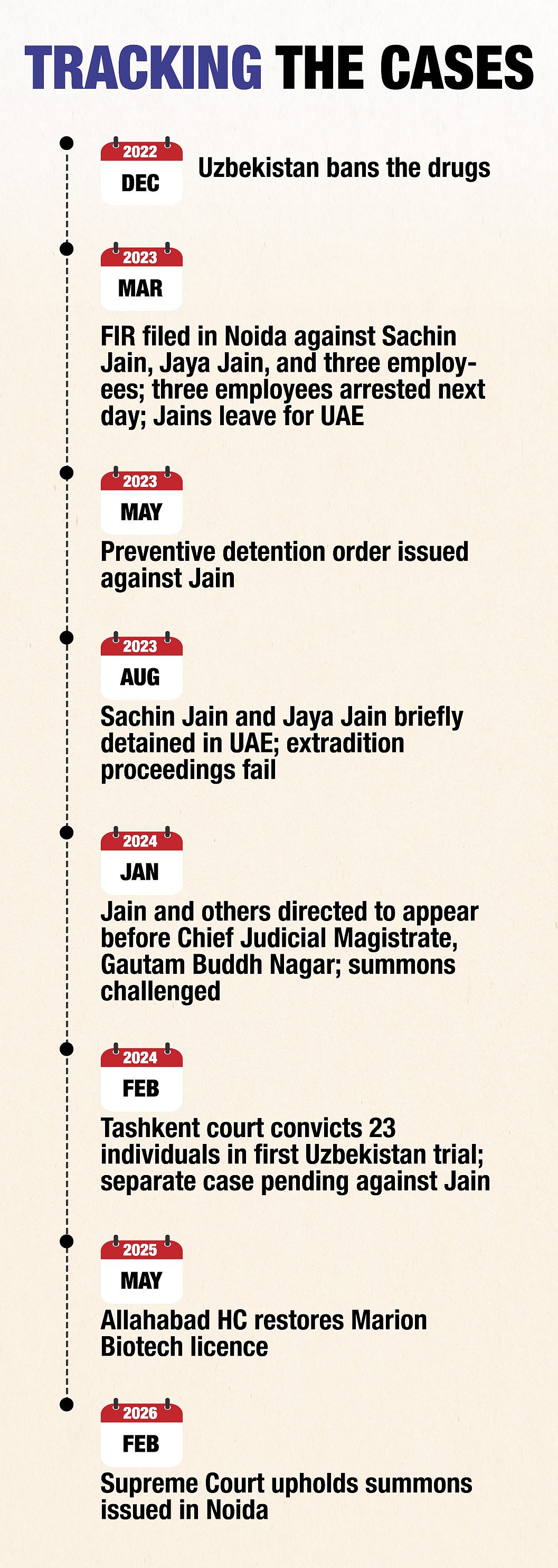
One year later, on February 26, 2024, a Tashkent court sentenced 23 individuals to prison terms ranging from two to 20 years and ordered compensation for victims’ families. Despite arrests, global alerts, lab findings, and a court order identifying Marion Biotech’s owner as having played a role, Jain was never arrested either in India or Uzbekistan. In fact, things soon returned to normal for the company.
Sachin Jain’s multi-national network
Marion Biotech Private Limited was incorporated in 1999. It has been exporting pharmaceutical products to countries such as Uzbekistan, Kyrgyzstan, Turkmenistan, Kazakhstan, Tajikistan, Azerbaijan, Georgia, Ukraine, as well as regions in Latin America, Africa, and Southeast Asia.
In Uzbekistan, which is one of its major export destinations, Marion Biotech distributed products through the Uzbek-registered Quramax Medikal LLC. Uzbek investigations pointed out that both companies were effectively controlled by Sachin Jain, who was described in the Tashkent court judgement as the “unofficial head” exercising operational and financial control.
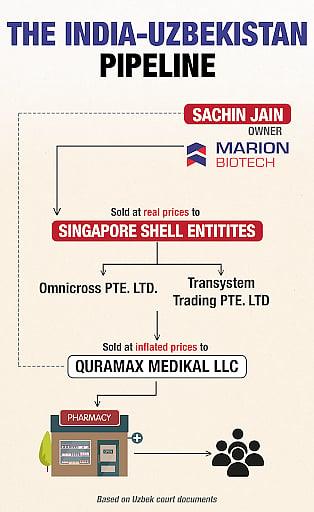
Although Sachin Jain held no executive title in the Uzbek company registry, investigative agencies and the court established that Jain was the founder, beneficial owner, and ultimate decision maker in Quramax Medikal LLC.
Newslaundry and The News Minute could not ascertain the ownership structure of Quramax Medikal LLC, which has several related entities.
However, according to investigations by the Uzbek State Security Service and tax department, and the Tashkent City Criminal Court’s judgement, Jain directed top executives such as Raghwendra Pratap Singh (director of Quramax Medikal), B Kambaraliev (sales director), E Mirzaakhmedov (chief accountant), and others, who were all operating out of Uzbekistan.
‘Tax evasion’
The Tashkent court also found that Jain and his employees allegedly conspired to evade tax by artificially inflating the declared import price of medicines and hiding the surplus earnings.
Rather than importing directly from Marion Biotech in India to Uzbekistan, the accused allegedly routed shipments through Singapore-based shell companies Omnicross Pte. Ltd. and Transystem Trading Pte. Ltd., which were also controlled by Jain. Marion Biotech sold drugs to these Singapore firms at their real price; the Singapore companies then resold them to Quramax Medikal at artificially inflated prices.
‘Cash to pharmacies and health staff to boost sales’
The court found that Sachin Jain transferred an amount equal to the actual value of the medicines to Marion Biotech’s account, while the remaining funds were allegedly withdrawn in cash and sent back to Uzbekistan through channels investigators were unable to fully trace. These off-book funds were used to bribe doctors, pharmacy heads, sellers, vaccine nurses, as well as to Quramax Medikal employees, to promote Marion Biotech products.
Digital forensic analyses of laptops and phones of Jain’s employees uncovered records of a ‘secret account’ tracking cash inflows and outflows not reflected in Quramax Medikal’s official accounts for 2020, the first half of 2021, and the second half of 2022.
The court recorded that these informal cash receipts totalled 24,420,162,100 soums (Rs 18.28 crore) in 2020; 13,783,339,400 soums (Rs 10.32 crore) in 2021; and 18,604,739,000 soums (Rs 13.93 crore) between June and December 2022.
Of the 2020 amount alone, Rs 3.78 crore was paid to doctors who recommended the medicines, Rs 9.78 lakh to nurses, and Rs 1.75 crore to pharmacies.
The court found that Quramax Medikal and Marion Biotech evaded tax amounting to Rs 5.4 billion soums (Rs 4.04 crore) from the period between 2021 and 2023.
‘Forgery and bribery to evade inspection’
Jain and his employees were also found to have forged registration applications while seeking to extend the market authorisation of their pharma products in Uzbekistan.
In October 2021, Quramax Medikal director Raghwendra Pratap Singh used the Marion Biotech stamp to authenticate forged applications for extending Dok-1 Max’s registration. He signed these documents in the name of Marion Biotech director V Tandon, and then used the company stamp allegedly provided by Jain. Dok-1 Max’s certificate was extended in March 2022, just three months before the first child death.
Bribes were allegedly used to avoid inspections.
In May 2022, Uzbekistan’s State Centre for Expertise and Standardisation of Medicinal Products decided to conduct a good manufacturing practice (GMP) inspection at Marion Biotech’s manufacturing facility in Noida during the registration process for the drugs Kuraraks 200 and Kuraraks 400.
The Tashkent court found that Jain knew the manufacturing conditions did not meet the required norms and an inspection of the facility would expose the mismatch and subsequently threaten all imports. Jain and Raghwendra Pratap Singh allegedly negotiated a bribe with a senior official from the State Centre. An initial demand of 45,000 USD was settled at 33,000 USD. On June 30, 2022, the money changed hands near Oybek metro station.
The inspection was cancelled. The factory remained unchecked. The next month, the first death linked to Dok-1 Max syrup was reported.
‘Fake registrations’
Employees linked to Jain allegedly paid bribes to obtain fake foreign registration certificates too, allowing Marion Biotech’s drugs to enter the Uzbek market without mandatory clinical trials.
In April 2022, Quramax Medikal director Singh approached an Uzbek Pharmacology Committee official named F Talipov Farrukh for approval of Tarireks 200 and Tarireks 400 antibiotic drugs manufactured by Marion Biotech. He was told the drugs could be registered without clinical studies if they were shown to be registered in at least one country other than the manufacturer’s country. Singh allegedly agreed to pay 1,100 USD for a forged Tajikistan registration certificate. The same method was repeated in mid-2022 for another drug.
Under Uzbekistan’s ‘Procedure for Recognition’, medicines already registered in 21 strict drug regulation countries, including the USA and Australia, can bypass the 210-day registration process and clinical trials. Jain was found to have arranged fake Luxembourg registrations for 11 medicines in collusion with State Centre deputy director N Musaev. It is not clear whether these drugs were manufactured by any company linked to Marion Biotech.
A pending case in Uzbekistan
On February 26, 2024, the Tashkent City Criminal Court convicted 23 individuals for their roles in the cough syrup tragedy. Those found guilty included employees of Quramax Medikal, officials from the Uzbekistan Pharmaceutical Industry Development Agency, and staff members of the State Centre for Expertise and Standardisation of Medicines.
Sentences ranged from two to 16 years in prison. The longest term, 20 years, was awarded to Quramax Medikal director Singh, who, according to the court, acted on Jain’s instructions.
Despite being identified by the court as the person who exercised actual control over the entire criminal enterprise and colluded with others to acquire, store, transport, and sell low quality drugs that led to the deaths, Jain was not sentenced or convicted in the trial.
A separate criminal case against him is pending trial in Uzbekistan. A preventive detention order was issued against him in absentia in May 2023. He has not been arrested by Uzbek authorities. Uzbek agencies had issued an Interpol notice against him. He and his wife were briefly detained in UAE in August 2023 but the extradition proceedings did not succeed.
Singh, meanwhile, is in jail in Uzbekistan. His wife has been writing to the Indian Embassy in Uzbekistan and even to External Affairs Minister S Jaishankar claiming that he has been made a scapegoat. The family wants Singh to be transferred to an Indian prison.
A source close to Singh’s family said, “His wife, who is of Ukrainian descent, is still in Uzbekistan. His family in India has approached the government seeking help. According to them, the responsibility lies with the manufacturer Marion Biotech. Singh had no role in production or technical matters and was involved only in distribution and was never informed that the syrups contained DEG and EG. Whatever actions he took in distribution were carried out as per instructions from Jain.”
HC protects from arrest, restores licence
After the FIR was lodged against them in Noida in March 2023, Sachin Jain and his wife Jaya moved the Allahabad High Court seeking the quashing of the case.
The next month, the court granted the couple substantial protection. It told the police not to arrest or prosecute the petitioners and even said the FIR should not have been filed in the first place since it was not a cognisable offence under the Indian Penal Code, and should have been dealt with instead via a complaint before an “appropriate forum”. It refrained from quashing the case citing a Supreme Court direction.
The couple had left India even before this order by Justices Anjani Kumar Mishra and Nand Prabha Shukla.
The High Court later granted the company relief in terms of the licence.
The Uttar Pradesh drug control authority had permanently suspended Marion Biotech’s manufacturing licence on March 13, 2023. In June, Jain appealed before the Appellate Authority, the Special Secretary, Food Safety and Drug Administration, Government of Uttar Pradesh. On September 14, the Drug Licensing and Control Authority permitted the company to manufacture drugs other than syrups requiring propylene glycol.
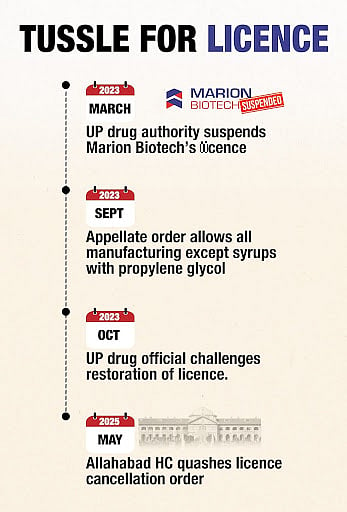
In October 2023, the Assistant Commissioner (Drugs), Headquarters, Food Safety and Drug Administration, Uttar Pradesh, Lucknow filed a review application against the appellate order allowing Marion Biotech to manufacture drugs. The appellate authority subsequently cancelled its earlier permission to produce any kind of drugs.
In 2024, Marion Biotech approached the Allahabad High Court challenging the appellate authority’s action. On May 19, 2025, Justice Dinesh Pathak quashed the licence cancellation order passed by the Uttar Pradesh drug controller, effectively allowing Marion to produce drugs again.
Justice Pathak said, “I am surprised to see that Indian authorities are trying to validate their proceedings conducted under the Indian law on the basis of judgement passed by the Supreme Court of the Republic of Uzbekistan. Indian laws relating to drugs are an exhaustive and self-sufficient code that do not require any validation of the judgement passed by a foreign court.” He added that nothing beyond “certain observations with regard to the quality of drugs” had been demonstrated from the foreign court’s orders and these observations were “subsequently modified to certain extent”.
A former Uttar Pradesh FDA senior drug official, who played a key role in cancelling Marion Biotech’s licence in 2023, said the inspection had pointed to “serious lapses”.
“We found serious lapses in the procurement and testing of propylene glycol, which is the main solvent used in syrups. It was procured without proper drug licence details, batch numbers, or valid certification. There were no defined drug quality specifications, and no tests were conducted to check whether it contained DEG or EG. The [propylene glycol] supplier’s name was not even listed in the approved vendor list,” he said.
He added, “There were also widespread breaches of good manufacturing practices (GMP). Hygiene was severely compromised, there was seepage, some equipment was rusted, and temperature and humidity monitoring devices were not functioning. Overall, it was a very poor state of affairs.”
While Marion Biotech was back in business with its licence restored, the court’s protection against arrest did not last.
In January 2024, Jain, his wife, and three others were directed to appear before the Chief Judicial Magistrate of Gautam Buddh Nagar in the same FIR lodged at Noida Phase-3 police station. Marion Biotech challenged this order before the Allahabad High Court through a criminal revision petition.
The company claimed that testing for DEG and EG “was not mandated” and described the complaint as “bald and fleeting” in attributing liability to directors and officials, arguing that it failed to allege direct involvement, consent, connivance, or neglect. But on January 14, 2026, Justice Harvir Singh of the Allahabad High Court dismissed the petition.
Marion Biotech, along with its directors and employees, then challenged the summons before the Supreme Court, which not only refused relief but delivered scathing remarks before dismissing the petition.
On February 19, 2026, a bench comprising Chief Justice of India Surya Kant and Justices Joymalya Bagchi and Vipul M Pancholi said the petitioners “should be prosecuted under more stringent sections”. “Your syrup was found to be responsible for the death of children. You should be charged with murder too…Go, appear before the authorities. So many children have died…Something like this brings a bad name to the country.”
Asked about the status of the Noida case, Phase-3 police station SHO Manoj Singh said, “FIR was registered but presently there is no update on the case. We have not received any order from the court yet to take action against Marion Biotech.”
In court proceedings related to the cough syrup case, Jain has argued that his designation alone does not establish criminal liability. He holds a 76.59 percent stake in Marion Biotech, while Jaya Jain owns 11.89 percent. The remaining 9.02 percent and 2.50 percent are held by Euston Projects and Vidur Developwell Private Limited respectively, both companies owned by Jain.
After the inspection of the Marion Biotech plant, the company’s legal head had in December 2022 denied all the allegations against the company and even hinted at the possibility of a conspiracy, asking why many deaths were reported from a single hospital.
The real estate man in pharma
Now 54, Jain started his innings with Emenox Infratek, before incorporating Marion Biotech a year later in 1999. Together, Sachin and Jaya Jain are directors in roughly two dozen companies, most of which list real estate as their primary business. Others deal in healthcare and textiles. Jain is associated with around 28 companies; Jaya with at least 21.
At least a dozen of these share one address: 1497, Bhardwaj Bhawan, Bhishma Pitamah Marg, Kotla Mubarakpur.
Despite this broad portfolio, Marion Biotech stands out as the principal revenue generating company for Jain. The company reported cumulative revenue of around Rs 650 crore between 2015 and 2024, according to the Ministry of Corporate Affairs (MCA).
Even during regulatory action by Uzbek and Indian authorities in 2022–23 and 2023–24, it continued to report substantial earnings. In 2022-23, Marion Biotech recorded a turnover of Rs 93.11 crore and a profit of Rs 21.13 crore. In 2023-24, it reported Rs 47.99 crore in turnover and Rs 10.91 crore in profit.
In contrast, another health venture of the Jains called Emenox Healthcare shows no reported revenue in MCA records for the latest financial year.
A few companies under Jain’s directorship appear to display little visible business activity. Their financial presence seems to emerge largely through related-party transactions — loans extended to them by Marion Biotech. In 2021 alone, Marion gave Rs 35.83 crore to Ozone Buildwell, Rs 8.13 crore to Green Noida Health and Research Institute Hospitals, and Rs 32.19 lakh to Trivelli Projects.
Two real estate entities – Belgravia Projects Pvt Ltd and La Solara Projects Pvt Ltd – show relatively greater operational visibility. Belgravia Projects, however, faces legal disputes from home buyers alleging delays and non-delivery.
For instance, in 2017, home buyer DP Dhankar filed a case at the Delhi Consumer Disputes Redressal Commission after allegedly waiting 14 years for possession of a flat in Belgravia’s Brave Hearts project in Ghaziabad, which was marketed for central police force personnel. Dhankar entered into a sale agreement in 2010 with an assurance of possession within two years. Despite paying Rs 26 lakh, which was Rs 3 lakh above the agreed cost, the flat was not handed over.
Questionnaires sent to the email addresses mentioned on the websites of Marion Biotech, Ozone Buildwell, Green Noida Health and Research Institute Hospitals, and Trivelli remain unanswered. When contacted on the phone number listed on the Marion Biotech website, the person who answered the call said it was a wrong number. Questions were also sent to the lawyers representing the company and the Jains.
Amulya Nidhi, health activist and national convenor of Jan Swasthya Abhiyan, said, “The response at both the regulatory and judicial levels was not proportionate to the gravity of the situation. In cases involving fatalities, there should be long-term and meaningful penalties. Here, the basic principles of justice appear to have been compromised, and that is why such incidents risk repeating themselves. All children are important. If 68 children had died in India due to a cough syrup manufactured by an Uzbek company, would our authorities and courts have reacted in the same way?”
We take no ads, bow to no government or corporation, and answer only to you, the reader. This Press Freedom Month, pay to keep news free.
Newslaundry is a reader-supported, ad-free, independent news outlet based out of New Delhi. Support their journalism, here.