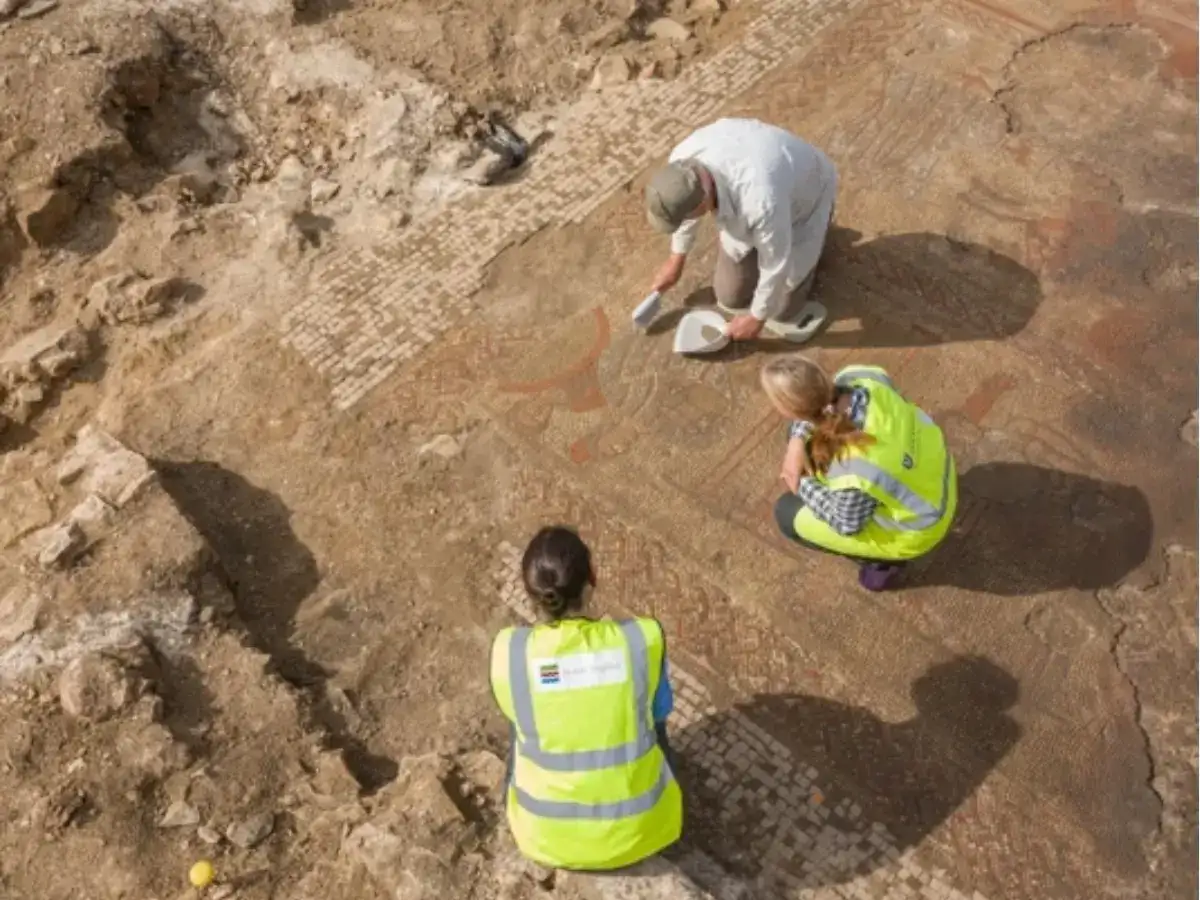
A routine field work on an agricultural field in Rutland, England became one of the most outstanding findings related to Roman history made by British archaeologists in recent years. The finding of ceramic shards and odd patterns in the crop eventually allowed scientists to find traces of an extremely rare Roman mosaic, belonging to a luxurious villa of the period of late Roman Britain.
International experts have expressed interest in this discovery as it indicates the extent to which rich Roman culture penetrated into rural areas, rather than being confined only to urban settlements. The finding of the mosaic, according to the University of Leicester, started in 2020 after noticing unusual cropmarks and fragments of ceramic tiles on the inspected piece of land. This eventually helped identify the exceptionally well-preserved mosaic flooring, which used to be part of the Roman elite dining room.
Tiny hints helped make a groundbreaking discovery
The finding could hardly have been expected during regular excavations. Experts believe that the first signs of the artifact were quite obscure. Cropmarks often occur due to the presence of walls or foundation structures beneath the ground affecting plant growth. Afterwards, excavations led to a formal excavation project which started in August 2020. A huge Roman villa complex and a figurative mosaic were discovered.
These experts highlight why studying visible features in the land can be important in archaeology. Professor Sarah Parcak, one of the best-known archaeologists for remote sensing studies and ancient landscape exploration explained that tiny differences in the landscape can mean finding lost ancient settlements. She continued that what appears to be an unremarkable field can hold remarkable evidence of the past.
This mosaic was found in the latter part of Roman Britain
According to researchers, this villa was built during the third and fourth centuries AD, specifically when Roman Britain was at its latter periods. Based on the reports by Historic England, it is believed that the property operated until the late fourth century AD. This finding contradicts previous beliefs of Roman Britain experiencing decline in the latter centuries AD.
The Roman villa at Rutland indicated that some wealthy individuals still made big investments in luxury properties and art during that time period. According to the University of Leicester, the owners extended the property and added an elaborately decorated dining room to showcase Roman cultural values. This indicates that the residents of the property were more than mere survivors of the last days of the Roman Empire. They actively showed off their affluence.