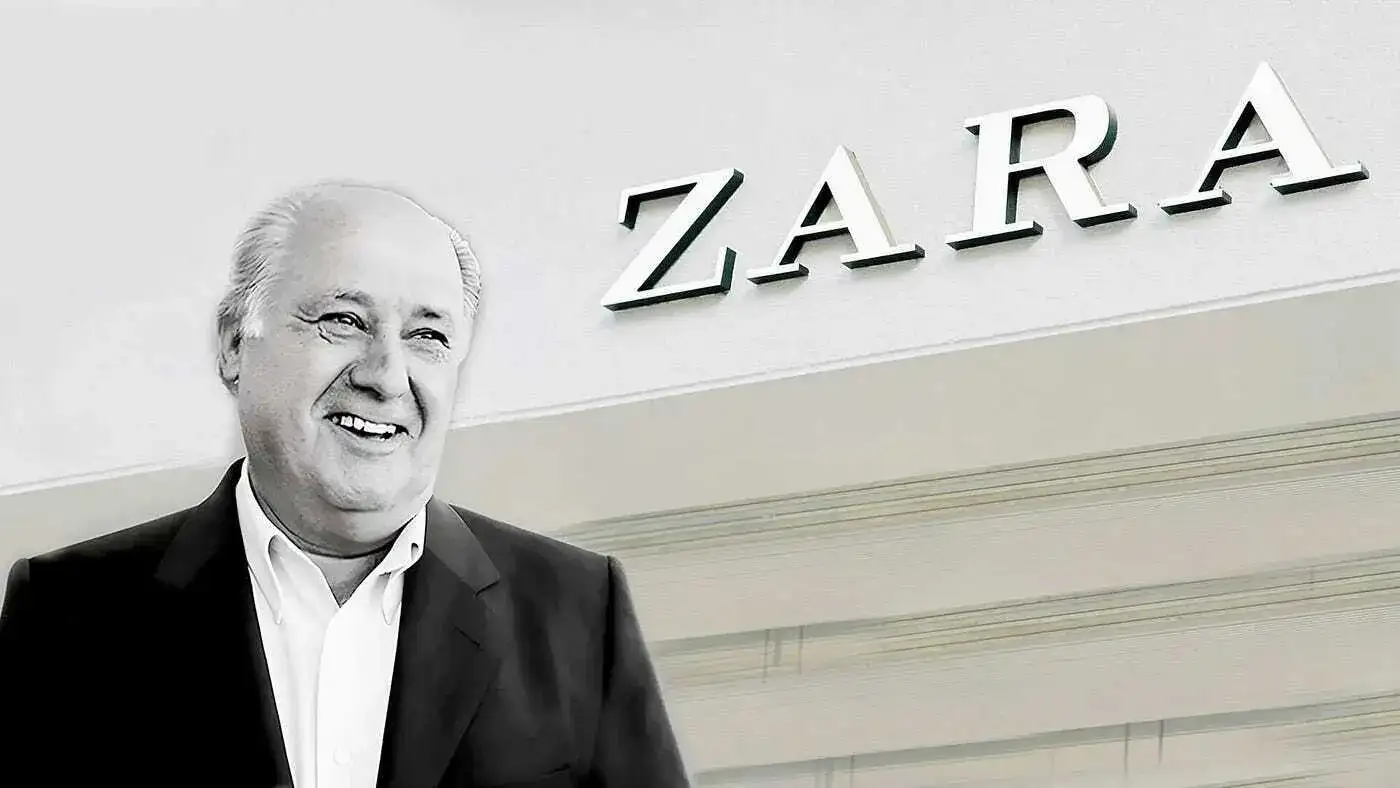
Amancio Ortega didn't go to college. He didn't inherit a fortune. He started at 13, folding shirts in a small shop in La Coruña, Spain—a city most of the world had never heard of. Yet Amancio Ortega would go on to build Inditex and the Zara empire into the largest fast fashion machine on the planet, eventually overtaking Bill Gates as the world's richest person. That story—raw, methodical, almost invisibly executed—is one of the most important business narratives of the last century. And most people still don't know his name.
Today, Inditex—the holding company Ortega founded in 1985—generates an estimated $31 billion in annual revenue. Ortega personally owns 59% of it. His real estate holdings through Pontegadea are valued at $17.2 billion, spanning Miami skyscrapers, Amazon's Seattle offices, and energy stakes in Spain. The man who began by sewing bathrobes with his siblings now controls an empire that stretches across 77 countries.
Amancio Ortega and the birth of Zara: A model no one had tried
Before Zara, the fashion calendar ruled everything. Designers would create collections months in advance. Stores would receive inventory twice a year. Customers would wait. Trends would arrive late or miss them entirely. Amancio Ortega decided to break that cycle entirely—not through disruption theater, but through ruthless operational efficiency.
Ortega built a manufacturing and design loop that could take a runway look and deliver it to store shelves within two weeks. Competitors were working on timelines of six months or more. That gap—between what was fashionable and what was available—was the exact space that Zara was designed to fill.
How did Amancio Ortega become the world's richest person?
By 2015, Amancio Ortega's net worth briefly surpassed Bill Gates, placing him at the top of the global wealth rankings. The moment was both surprising and logical. Inditex had been compounding quietly for decades—expanding into Portugal, then France, then the United States, then 77 countries. The Zara brand became a template; Inditex added Massimo Dutti, Pull&Bear, Bershka, and other labels underneath it, widening the reach without diluting the core model.
When Inditex went public in 2001, it raised $2.7 billion in one of Spain's largest-ever IPOs. The market immediately recognized what insiders already knew: this was not a typical retailer. It was a vertically integrated, data-driven machine with structural advantages almost impossible to replicate.
What can entrepreneurs learn from the Amancio Ortega business model?
The lesson most people draw from Amancio Ortega is speed. Get products to market faster. React to trends in real time. While that's true, it misses the deeper principle. Ortega's real achievement was designing a system that got smarter the longer it ran. Every store visit, every sale, every item left on a rack fed information back into the machine. Zara wasn't just selling clothes.
Ortega also understood the psychology of scarcity without cruelty. Zara's limited inventory per style created urgency without alienating customers. If you saw something you liked, you bought it—because it might not be there next week. That tension, engineered deliberately, drove foot traffic and repeat visits at a frequency that department stores could never match. A Zara customer visits an average of 17 times per year. The industry average is closer to three.
The fashion industry before Zara was, in many ways, a closed conversation. Luxury brands spoke to the wealthy. Mass retailers offered affordability but not aspiration. Amancio Ortega found the gap between those two worlds and built a bridge through it. Zara made runway-adjacent clothing accessible to ordinary incomes without making it feel cheap.
The consequences rippled across the entire industry. H&M, Topshop, Forever 21—every fast fashion brand that followed owed its business model, at least in part, to the template Ortega had established. His critics would note that fast fashion also created enormous environmental pressure: overconsumption, textile waste, labor concerns.
The Zara empire isn't just a fashion story. It's a lesson in how systems, patience, and deep operational thinking can compound into something no single genius move could ever produce. Amancio Ortega didn't disrupt fashion. He rewired it from the inside—one quickly sewn garment at a time.